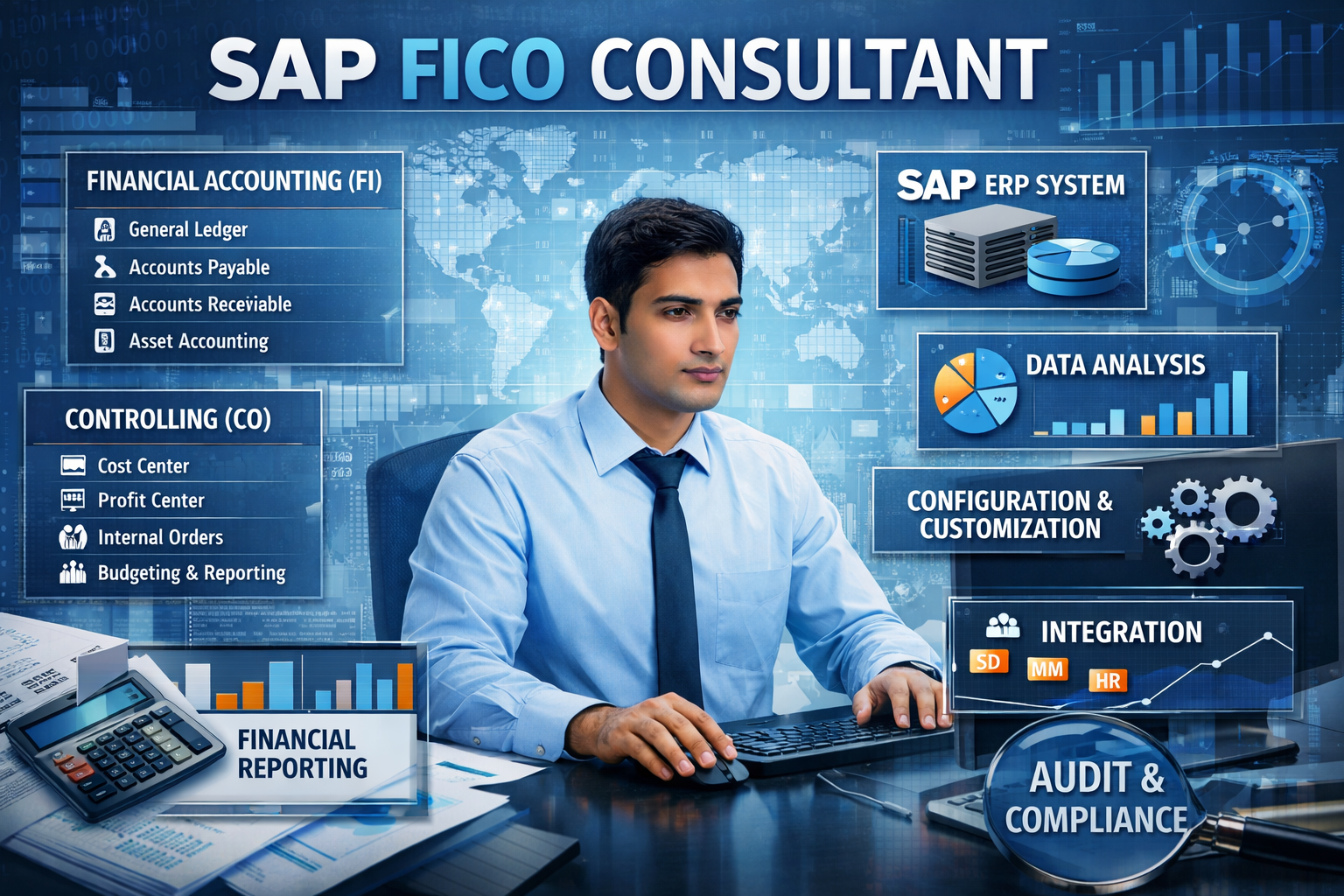
Currently, the corporate world in 2026 is based on speed, precision, as well and decision-making. This transformation is dependent on the SAP S/4HANA, the powerhouse ERP system that keeps multinational companies running smoothly. Among the various models, SAP FICO (Financial Accounting and Controlling) remains the most important and acts as a financial “nerve center” of an organization.
In this article, we will discuss in detail why becoming a SAP FICO consultant is more than just a job, as well as a highly responsible role that integrates deep financial knowledge with tech mastery. So if you are an IT professional who is looking to switch, you need specific skills. For the people who take SAP FICO Training in Hyderabad can help you reach your goal more easily than ever. So let’s begin discussing these specific skills in detail:
Skills Required to Become a SAP FICO Consultant:
These are some of the skills that one needs to become a SAP FICO Consultant. Well, you can take SAP FICO Online Training that can help you learn at your own pace from anywhere.
1. Domain Expertise:
Before you begin to use the SAP system, you must understand the language of business, which is accounting. SAP FICO is a tool used to implement accounting processes; if you don’t understand the logic behind a transaction, you cannot configure the software to handle it.
- Financial Accounting (FI):
You need to be comfortable handling the General Ledger, Accounts Payable, and Accounts Receivable. It isn’t just about data entry; you must truly understand how these pieces come together to build a Balance Sheet and a Profit & Loss statement.
- Management Accounting (CO):
This is about internal reporting. You must understand Cost Center Accounting, Profit Center Accounting, and Internal Orders.
- Regulatory Knowledge:
In 2026, global compliance is strict. A consultant must be familiar with standards like IFRS (International Financial Reporting Standards) and local tax laws like GST in India or VAT in Europe.
2. Technical Configuration Skills:
This is where the “Consultant” part of your title comes into play. A SAP FICO pro doesn’t just enter data, but they build the system that everyone else uses.
- Enterprise Structure:
You must know how to define and assign organizational units like Company Codes, Business Areas, and Credit Control Areas.
- Master Data Management:
Setting up the “Chart of Accounts” and managing vendor/customer master data is a daily task.
- Integration Knowledge:
SAP doesn’t work in a vacuum. You need to understand how FICO talks to other modules. This includes:
- FI-MM Integration:
Linking finance with Materials Management (procurement).
- FI-SD Integration:
Linking finance with Sales and Distribution (revenue recognition).
3. Mastering SAP S/4HANA and Fiori:
In the year 2026, the traditional SAP ECC system won’t be in use anymore. So the modern consultants need to be experts in SAP S/4HANA Finance.
- The Universal Journal:
Understanding how the “Universal Journal” (ACDOCA table) combines all financial data into one single line-item table is important for high-speed reporting.
- SAP Fiori:
You need to be an expert in using the Fiori Apps that offer a modern, as well as mobile-friendly user interface.
- Central Finance:
Many companies use SAP to pull data from multiple systems. Knowing how to set up “Central Finance” is a high-demand skill that sets senior consultants apart.
4. Analytical and Problem-Solving Skills
A large part of a consultant’s life is spent in “Support” or “Implementation” mode. When a billion-dollar company’s month-end closing fails, they look to you to find the “bug.”
- Gap Analysis:
You must be able to look at a company’s current manual process and figure out the “gap” between what they do and what SAP can offer.
- Troubleshooting:
You need the patience and logic to trace errors through transaction codes (T-Codes) and find out where the configuration went wrong.
- Testing:
Mastery of Unit Testing, Integration Testing, and User Acceptance Testing (UAT) ensures that the system doesn’t crash during “Go-Live.”
5. Soft Skills: The “Bridge” Between Business and Tech:
When you talk to the CFO about “return on investment” and then talk to the developers about “functional specifications.”
- Communication:
You must be able to explain complex technical concepts in simple terms to business users.
- Documentation:
From creating “Business Blueprints” to writing “User Manuals,” your ability to document every step of the configuration is vital for long-term project success.
- Change Management:
People often resist new software. A great consultant helps the staff transition smoothly from their old ways of working to the new SAP environment
Well, if you take SAP FICO Training in Chennai, then it focuses mainly on working on real cases from the automotive and manufacturing sectors. This can help you understand how the SAP works.
Conclusion:
If you are looking to become a SAP FICO Consultant in 2026, then you need to understand that it is a journey of continuous learning. Technology changes with the time, but what stays consistent is the principles of finance. So when you use technical skills with strong accounting skills, this can help you build a career that is rewarding as well as future-proof.