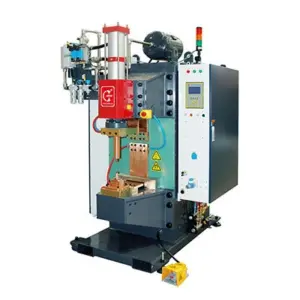
In today’s competitive manufacturing landscape, efficiency, precision, and reliability are paramount. For industries ranging from automotive to aerospace, the resistance welder has become an indispensable tool, offering high-speed, high-quality metal joining while minimizing material distortion. At Heron Welder, we specialize in delivering advanced resistance welding solutions tailored for OEMs, automation integrators, and manufacturing engineers seeking robust and repeatable results.
What is a Resistance Welder?
A resistance welder is a type of welding machine that joins metals by applying pressure and passing electrical current through the materials to create heat via electrical resistance. Unlike traditional welding methods that rely on external heat sources, resistance welding leverages the inherent electrical resistance of metals to generate localized heat precisely where it is needed.
The key components of a resistance welding system include:
-
Electrodes: Conduct electricity into the metal and apply force to hold parts together.
-
Transformer: Supplies controlled current to generate the heat.
-
Control unit: Ensures precise timing, current, and pressure for consistent weld quality.
-
Pressure system: Maintains electrode force during the welding cycle.
By combining these components, resistance welders create strong, durable joints with minimal energy consumption and high repeatability.
Types of Resistance Welders
Heron Welder offers a wide range of resistance welding machines to meet diverse manufacturing needs. The most common types include:
1. Spot Welders
Spot welding is ideal for joining sheet metals at discrete points. It is widely used in the automotive industry for assembling body panels, HVAC manufacturing, and appliance production.
2. Seam Welders
Seam welding produces continuous, leak-proof joints, perfect for fuel tanks, pipes, and metal drums. The electrodes roll along the seam, providing consistent quality over long weld lines.
3. Projection Welders
Projection welding concentrates the welding current on raised projections, enabling precise multi-point welds. This is ideal for fasteners, brackets, and components with complex geometries.
4. MFDC and Capacitor Discharge Welders
Medium-Frequency Direct Current (MFDC) and Capacitor Discharge (CD) resistance welders are specialized solutions for high-speed, high-precision applications. MFDC welders are energy-efficient and suitable for thin metals, while CD welders excel in joining delicate or small components with minimal thermal distortion.
Applications of Resistance Welding
Resistance welding is highly versatile and spans numerous industries:
-
Automotive Manufacturing: Body panels, battery packs, exhaust systems, and structural components.
-
Aerospace & Defense: High-strength joints in critical structural assemblies.
-
Electrical & Electronics: Terminal connections, bus bars, and small component assembly.
-
Appliances & HVAC: Enclosures, brackets, and tubular assemblies.
-
Industrial Fabrication: Metal furniture, metal racks, and machinery components.
Heron’s resistance welders are designed to integrate seamlessly into automated production lines, improving throughput while maintaining consistent quality.
Advantages of Resistance Welding
Choosing a resistance welder offers several key benefits for manufacturers:
-
Speed & Efficiency: Weld cycles are extremely fast, enabling high-volume production.
-
Consistency & Quality: Automated controls ensure repeatable welds with minimal defects.
-
Material Conservation: Localized heating reduces distortion and preserves material properties.
-
Safety & Clean Operation: No open flames, minimal fumes, and reduced risk of workplace hazards.
-
Integration with Automation: Resistance welders can be incorporated into robotic and conveyor systems for seamless mass production.
Best Practices for Resistance Welding
To maximize the performance of a resistance welder:
-
Select the Right Electrode Material: Copper alloys are preferred for excellent conductivity and durability.
-
Maintain Proper Electrode Force: Consistent pressure prevents weak or excessive welds.
-
Optimize Weld Current and Time: Adjust based on material thickness, type, and joint design.
-
Regular Maintenance: Periodically clean electrodes and check alignment to ensure long-term performance.
-
Integration Planning: When automating, coordinate with line engineers for optimal placement and cycle times.
Heron Welder provides expert guidance to ensure these best practices are tailored to your specific application and production requirements.
Resistance Welding vs. Other Metal Joining Methods
| Method | Key Advantage | Typical Use Case |
|---|---|---|
| Resistance Welding | Fast, clean, precise | Automotive panels, brackets |
| MIG/TIG Welding | High flexibility, thicker metals | Structural steel, fabrication |
| Laser Welding | Ultra-precision, minimal distortion | Electronics, aerospace components |
| Mechanical Fastening | No heat required, reversible | Sheet metal assemblies, HVAC ducts |
While other methods have their place, resistance welding excels in automated, high-volume production environments where speed, consistency, and reduced thermal impact are critical.
Why Choose Heron Welder?
Heron Welder is a global leader in resistance welding solutions, combining cutting-edge technology with decades of industry expertise. Our machines are engineered to meet the demanding standards of OEMs, integrators, and production engineers, delivering:
-
Fully customizable resistance welding systems for any production requirement.
-
Seamless integration with automated assembly lines and robotic systems.
-
Expert consultation and support, ensuring your operations achieve maximum uptime and efficiency.
FAQs
1. What metals can a resistance welder join?
Resistance welding works best with steel, stainless steel, aluminum, copper, and nickel alloys, depending on electrode type and machine settings.
2. How fast can resistance welding cycles be?
Spot welding cycles can be completed in milliseconds, while seam welding depends on material speed and electrode design.
3. Is resistance welding energy-efficient?
Yes. By generating heat only at the weld interface, resistance welders minimize overall energy consumption compared to traditional welding methods.
4. Can resistance welders be automated?
Absolutely. Heron welders are designed for full integration with robotic arms, conveyors, and automated quality inspection systems.
5. How do I choose the right resistance welder for my production line?
Consider material type, thickness, production volume, and joint design. Heron Welder provides detailed consultation to select the ideal solution.
Take the Next Step with Heron Welder
Optimizing your production line requires precision, speed, and reliability. With Heron’s advanced resistance welders, you gain a trusted partner for customized welding solutions that meet your manufacturing goals.
Request a quote or consult with our experts today to explore how Heron Welder can enhance your operations with high-efficiency, automated, and industry-leading resistance welding technology.