In Singapore, it’s easy to look fine on the outside and still feel like you’re running on fumes. Long workdays, packed calendars, family expectations, and the pressure to keep performing can slowly turn into anxiety, burnout, irritability, sleep issues, or that constant I’m behind feeling. If any of that sounds familiar, Psychotherapy Singapore isn’t about labeling you or “fixing” you—it’s about getting unstuck with practical support that fits your real life.
Over the last few years, the conversation has shifted. People aren’t only seeking help when things fall apart. More clients in Psychotherapy Singapore are high-functioning professionals, founders, students, and parents who want better emotional range: fewer spirals, less reactivity, stronger boundaries, and a clearer sense of what they actually want. Clinics like Thrive Psychology see this every day—therapy isn’t a last resort anymore; it’s a skill-building space.
Why do smart, capable people still feel overwhelmed?
Because capability doesn’t protect you from stress physiology. You can be competent and still have a nervous system that’s stuck in on mode. In Psychotherapy Singapore, many clients describe the same loop:
- You push through fatigue with caffeine and willpower.
- You fall behind on rest, relationships, and recovery.
- Your body starts protesting—tight chest, headaches, poor sleep, brain fog.
- You blame yourself instead of the system.
Good Psychotherapy Singapore work doesn’t just talk about feelings—it maps patterns. What triggers you? What keeps the pattern going? What are the smallest changes that actually create relief?
At Thrive Psychology, this often means starting with the basics: sleep, workload boundaries, rumination habits, and the way you talk to yourself when things don’t go perfectly. That foundation matters even when you’re using newer tools like Virtual Reality Therapy as part of treatment.
What does effective therapy look like in real life?
If therapy is working, you usually notice it outside the session first. In Psychotherapy Singapore, clients report things like:
- I still get anxious, but it doesn’t hijack my whole day.
- I can bring up hard topics without freezing or exploding.
- I’m sleeping better, and I’m less reactive at work.
- I stop spiraling after a mistake.
That’s the goal: better regulation, stronger decision-making, and more control over your attention. Evidence-based Psychotherapy Singapore often includes approaches like CBT (for anxious thinking), ACT (for values and flexibility), trauma-informed work (for stuck threat responses), and skills training (communication, boundaries, emotional regulation).
Thrive Psychology typically frames this as progress you can measure—what’s different week to week, what situations feel easier, what coping tools actually stick.
Why do some problems refuse to logic their way out?
Because not everything lives in the rational brain. If you’ve tried every productivity hack and still feel dread, it’s usually not a knowledge gap—it’s a nervous system pattern.
That’s where Psychotherapy Singapore can go beyond insight. You can understand your triggers and still have a body that reacts as if danger is present. This is especially true for:
- panic symptoms
- social anxiety
- trauma reminders
- phobias
- performance anxiety (presentations, interviews, exams)
When exposure work is appropriate, Virtual Reality Therapy can be a useful bridge between “talking about it” and “doing it in real life.”
How can immersive tools help with fear, panic, or avoidance?
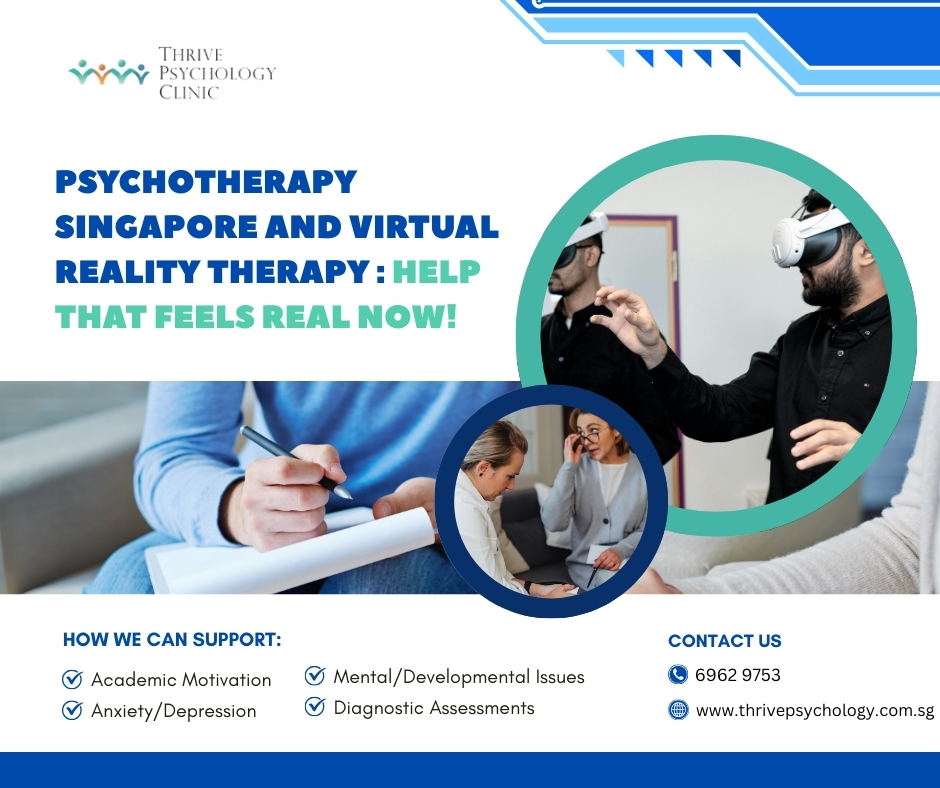
Let’s keep it practical. Virtual Reality Therapy uses controlled, therapist-guided simulations to help clients face triggers safely and gradually. Instead of waiting for a real-world situation to appear (and then avoiding it), you can practice inside the clinic.
In Psychotherapy Singapore, this can be relevant for scenarios like:
- fear of public speaking (standing in a virtual room, building difficulty step by step)
- fear of heights (controlled elevation environments)
- transport or travel anxiety (trains, elevators, flights—depending on the program)
- social anxiety (virtual social settings where exposure can be paced)
The value of Virtual Reality Therapy is control. The therapist can adjust intensity in real time, track distress levels, and help you learn regulation skills while the trigger is present. Used well, Virtual Reality Therapy isn’t a gimmick—it’s structured practice.
At Thrive Psychology, Virtual Reality Therapy is typically positioned as an add-on within a broader plan, not a standalone quick fix. That’s important for both outcomes and ethics.
Is tech-based therapy replacing the human part?
No—and it shouldn’t. Psychotherapy Singapore works because of a strong therapeutic relationship and clear clinical judgment. Tools are only as good as the plan behind them.
Think of Virtual Reality Therapy like a flight simulator for anxiety: it helps you rehearse skills under realistic conditions. But you still need the coach to teach the skills, spot safety behaviors (like holding your breath or mentally checking out), and translate progress into real-world action.
In good Psychotherapy Singapore practice, you’ll see integration:
- Identify the pattern (trigger → thought → body response → behavior)
- Learn regulation skills (breathing, grounding, attention shifting)
- Practice exposure (sometimes via Virtual Reality Therapy)
- Apply it outside (real-life experiments, habit changes, boundary work)
This combination is where many clients start seeing durable change.
What should you look for when choosing a clinic?
If you’re researching Psychotherapy Singapore, look for clarity over marketing. A trustworthy clinic should be able to explain:
- what approach they use and why it fits your concern
- what progress typically looks like
- how confidentiality works
- how they handle referrals if your needs change
You should also feel comfortable asking direct questions. In Psychotherapy Singapore, the best therapists welcome this because it protects quality. Thrive Psychology, for example, generally focuses on matching clients with the right clinician and setting expectations early—how many sessions might be needed, what homework looks like, and how outcomes are reviewed.
If a clinic offers Virtual Reality Therapy, ask how it’s used: for what conditions, with what structure, and how success is measured.
What does a first session usually involve?
Most first sessions in Psychotherapy Singapore aren’t “deep dives” right away. They’re more like a well-run discovery call—with warmth.
You’ll typically cover:
- what’s been happening and how long it’s been going on
- what you’ve tried so far
- what you want to be different
- any relevant history (stressors, health, past therapy, key relationships)
- a shared plan for next steps
If Virtual Reality Therapy is appropriate, it’s usually introduced after you’ve built baseline coping skills and agreed on exposure goals. Done responsibly, Virtual Reality Therapy is paced—not forced.
How do you know you’re making progress?
Here’s a simple way many Psychotherapy Singapore clients track progress: frequency, intensity, recovery time.
- How often do symptoms show up?
- How intense are they when they hit?
- How long does it take to recover?
If therapy is working, one or more of those numbers improves. You may still have hard days, but you bounce back faster and make cleaner choices.
In Psychotherapy Singapore, that’s what sustainable change looks like—less avoidance, more flexibility, better self-trust. And when Virtual Reality Therapy is part of the plan, progress is often visible: the trigger feels less “life or death,” and you can stay present while practicing skills.
Where do you start if you’re on the fence?
If you’re considering Psychotherapy Singapore but unsure, start with one honest question: What is this costing me right now? Sleep? Focus? Relationships? Confidence? If the answer is “more than I want to admit,” it’s worth a conversation.
A clinic like Thrive Psychology can help you figure out whether standard talk therapy is enough or whether structured exposure—including Virtual Reality Therapy—could support your goals. Either way, the win is the same: you stop white-knuckling your way through life and start building a mind that works with you, not against you.
If you want therapy that’s grounded, practical, and aligned with real-world demands, Psychotherapy Singapore can be a strong next step—with Thrive Psychology as one place to begin.