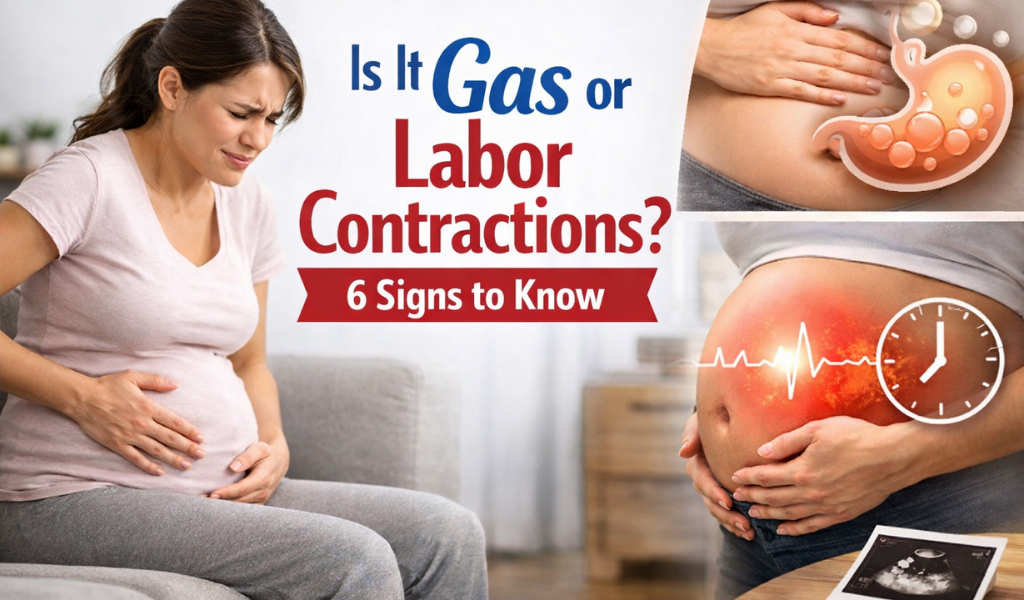
In the last weeks of pregnancy, any ache in the body can lead to endless questions in your mind. A bloated stomach after supper, a sudden cramp after a nap, or mild back pain at night can make you think, “Is it the time of labor, or is it just a food reaction?” This confusion is common in pregnancy because the hormonal change slows down the digestive system. And if your due date is close, it can be quite difficult to tell the difference between them. In this article, we will share with you the 6 signs that distinguish gas from labor pains.
Signs That Confirm Labor Contractions
It is important to know that the pain of early labor contractions can be similar to gas pain, but there are some ways to identify both of them. Below are the signs that make certain it is birth pangs.
1. Your Discomfort Has a Pattern
Contractions always occur in waves. It may start with light pain before getting intense, then become milder again. This process continues in a loop with breaks. On the other hand, gas pain is more frequent. Doctors say that during labor, you develop a pattern of uterine contractions that happens every 4 to 5 minutes and gets more intense with time. To double-check, you can use a stopwatch to note the timing of the contractions; if they occur at a fixed interval, head to the hospital immediately.
2. Your Belly Becomes Hard
Labor pains involve a strong muscle contraction in your abdomen and uterus. And during those muscle contractions, your stomach will become hard like a rock. The simplest way to sense labor pain is if your tummy tightens every time when you’re in pain and then settles afterwards, it’s most likely a contraction. However, if your stomach is filled with gas, then the muscles won’t get hard in sequence as it happens in contractions.
3. Other Symptoms
Other than muscle contractions, labor pain has several symptoms. You can notice blood in mucus or a change in vaginal discharge. Such symptoms can make sure that it’s real labor. One of the most important symptoms is the water breaking. If you don’t notice any of these symptoms besides abdominal pain, your pain can be caused by gas or other digestive problems.
Signs That Indicate Gas Pain
Gas pain is very common during pregnancy, and the reasons for it are the change in hormones and the pressure exerted by the baby on the digestive tract. To be certain, try to look for the symptoms of contractions. In the absence of those symptoms, it is most probably gas.
1. The Pain is Unpredictable and Sharp
There is no fixed period of gas. It may come and go and come again. The pain associated with it can be more intense than that of labor contractions, which can be any type of abdominal ache, such as menstrual cramps, food poisoning, etc. Gas present in your stomach will make you feel bloated.
2. You’ve Eaten Gassy Food
As we’ve discussed above, the baby puts pressure on the digestive tract. Some food you eat in pregnancy will induce gas. Sometimes, when you eat something spicy, greasy, fried, or fast food, it automatically builds up gas. Also, some cruciferous vegetables, such as cauliflower and broccoli and high-fiber foods, such as beans, are rich in baby-growing nutrients. They’re the prime suspect for filling your intestines and stomach with gas.
Onions, garlic, and carbonated beverages are also not good for the stomach during pregnancy. If the gas pain persists for a long time, then try to eat less gassy food in your diet until your baby is born.
3. Going to the Bathroom Gives Relief
Most of the time, gas pain reduces when you use the bathroom. If a restroom visit helps, then it will make sure that it is not labor contractions. In addition, doing some movement of your body, such as walking or doing light exercise and stretches, may help manage the gas pains, but it will not stop labor contractions. Even if you do some kind of activity in contractions to soothe the pain, it will only increase.
Closing Remarks
Gas and early labor contractions may have similar symptoms, but once you note the duration, intensity, and pattern of them, you can easily identify both of them. There are other symptoms, like blood-tinged mucus and water breaking, that can clearly indicate that it is labor contractions. In any case, if you’re not sure of what it is, visit a doctor immediately. If you have contractions, you’ll already be in the hospital. If it’s gas, the doctor will give you the medicine for it. It’s a win-win situation.
In all this confusion, do not compromise your comfort and support at all. Visit Lovemere to buy the best motherhood essentials, such as nursing bras, maternity bras, tops, dresses, pump bras, and so on.
FAQs
- How do I know if it’s gas or labor?
Ans: You can separate labor from gas by looking at the pattern and type of pain. Labor contractions are rhythmic and get intense over time. Gas pains are sharp but come and go on their own. Other signs of labor include a hard belly, lower back pain, bloody mucus, diarrhea, or your water breaking.
- Can gas pain feel like contractions?
Ans: Yes, gas pain can sometimes feel like contractions because it builds pressure and hardens the abdomen area. However, it may ease after passing gas or using the bathroom.
- Do labor contractions stop with movement?
Ans: No, labor contractions do not stop when you move, walk, or rest. They keep on coming and get more and more intense, even if you change positions. If your contractions stop with movement, it is gas.
- When should I go to the hospital?
Ans: You should go to the hospital when your contractions follow the 5-1-1 rule: they come every 5 minutes, last about 1 minute, and keep going for 1 hour. Go immediately if your water breaks, you have heavy bleeding (more than light spotting), or you notice your baby is moving less than usual.