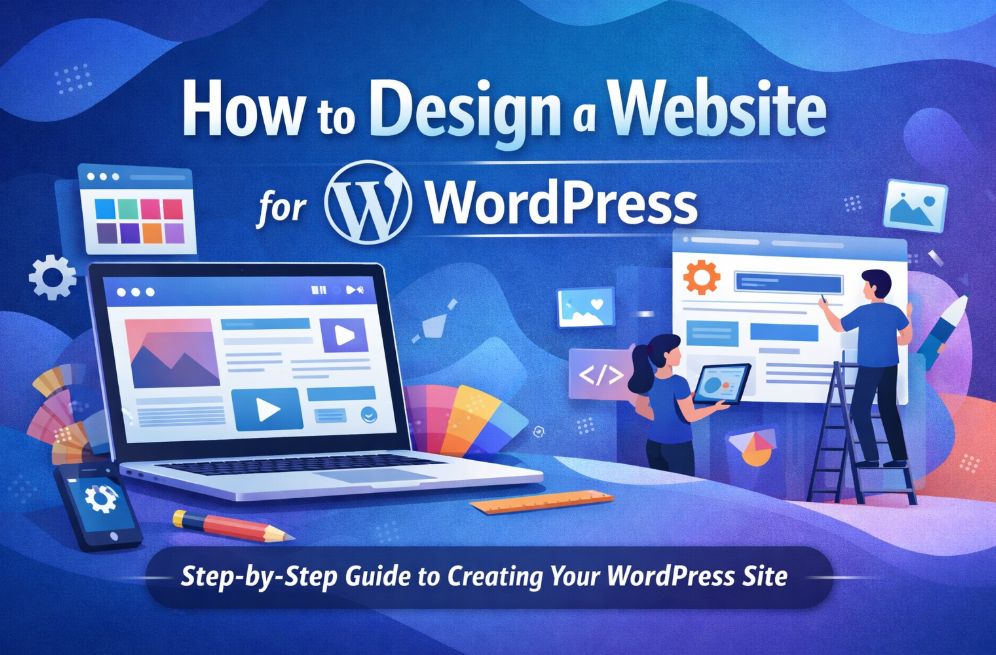
One of the most viable skills in the modern digital world is designing a site in WordPress. WordPress is one of the most used websites in the world due to its ability to be flexible and scalable to provide considerable ease of use even to non-technical users. WordPress provides the resources that enable you to develop a professional and functional design without the need to code one, whether you are creating a personal blog, a business website or an online store.
In this tutorial, we will step-by-step show you how to build a WordPress-based site, starting with planning and layout, to themes, plugins and optimization of performance. It aims to make everything simple and easy to understand so that anybody can follow. When promoting such brands as quantirum.com, one of the aspects that is emphasized is that good design does not only pertain to appearance, but to functionality, speed, and simplicity.
Understanding WordPress Website Design
It is worth first knowing what WordPress website design is all about before getting down to designing. WordPress site design is not the process of color and font selection only. It entails format, navigation, content format, responsiveness, and performance.
The way of WordPress design is often performed in terms of themes and page builders. Themes regulate the appearance of your site at large, whereas page builders enable you to design the layout visually without writing any code. The two are the basis of how your website will look and feel.
1: Define the Purpose of Your Website
Any successful WordPress website begins with a good purpose. The question to ask yourself is, why are you developing the website and what do you expect visitors to do when they visit?
An example of this is a business site, which emphasizes on trust, services and conversions and a blog, which emphasizes on readability and flow of content. The online store must have proper product designs and checkout systems. Design decisions are made much easier when the purpose is obvious.
Another thing to keep in mind at this point is to consider your target audience. Knowing their needs, tastes and how they browse will inform your design decisions in the design process.
2: Plan Your Website Structure
Website structure is the way your web pages are arranged and interrelated. A properly designed structure enhances their navigation and assists the search engines to know your site.
The WordPress sites usually have the basic pages, which are Home, About, Services or Products, Blog and Contact. The navigation menu must be easy and logical in order to enable users to find what they are interested in easily.
Do not put everything together at once but first form a clean structure. There is always the chance of expanding in the future as your web site evolves.
3: Choose the Right WordPress Theme
A WordPress theme is a general theme of your site. Free and premium themes exist in thousands, but it is important to pick the right one.
A good theme must be responsive i.e. it ought to be appealing on desktops, tablets and mobile devices. It must also load fast and be compatible with trendy plugins.
In choosing a theme, you should concentrate on layout and not on flashy images. Minimalism and clean theme is more customizable and less complicated to support. The numerous themes these days have their own customisation features, which enable you to change colours, font styles and layouts right in the WordPress dashboard.
4: Customize Your Design with Page Builders
Page builders make WordPress design much easier, especially for beginners. Tools like Elementor, Gutenberg, or Beaver Builder allow you to design pages using a drag-and-drop interface.
With page builders, you can visually arrange sections, images, text, and buttons without touching any code. This gives you full control over the appearance of each page.
Midway through the design process, many site owners consider a Website Redesign to improve layout, branding, or user experience. This is also the stage where designers often explore tools like Canva alternatives for UI/UX design to create custom graphics, banners, and visual elements that more effectively match the website’s branding.
5: Focus on User Experience and Navigation
User experience plays a major role in website success. A beautifully designed site will still fail if users find it confusing or difficult to navigate.
Your navigation menu should be clear and consistent across all pages. Fonts should be readable, and spacing should allow content to breathe. Avoid cluttering pages with too many elements, as this can overwhelm visitors.
Page loading speed also affects user experience. Optimized images, clean design, and lightweight themes contribute to faster performance and better engagement.
6: Design Key Pages Thoughtfully
Every page of your WordPress site has its purpose. Your home page must be able to tell the visitors clearly what your site entails and where to find the necessary areas. The About page needs to create trust with your story or the background of your business.
Service or product pages are supposed to be devoted to simplicity, describing the benefits in an easy language. The Contact page must be readily accessible and it must have clear methods of inviting visitors to get in touch.
Likewise, the fact that the design is similar on every page assists in offering a professional and reliable look.
7: Use Plugins to Enhance Design and Functionality
Plugins expand the functionality of WordPress and can help a great deal in enhancing your website design. It has SEO, security, performance, form, and design enhancement plugins.
One should however, not go on putting too many plugins in your site. Limit yourself to the necessities, and be sure that they are compatible and in good condition with your theme.
Image optimization, animations, sliders, and typography are tasks that can be facilitated with design-related plugins and do not require the heavy customization of your website.
8: Optimize for Mobile and Performance
The number of people visiting websites using mobile devices is a large percentage and hence the importance of mobile responsiveness. The majority of the contemporary WordPress themes are compatible with mobile devices, however, it is also necessary to make sure that your design works well in various screen sizes.
Another important point of WordPress design is performance optimization. Websites that load fast offer a better user experience and are better in search results. Some basic measures such as caching, compression of images and reduction of unnecessary scripts, can go a long way.
9: Test Before Launch
Testing is necessary before the website is made live in WordPress. Test every page, all links, forms and any other interactive items to make sure they are functioning properly.
Look at your website as a visitor. Ensure that the material is readable, navigation is not too hard and the design appears to be similar on different gadgets and browsers. The majority of little problems should be fixed before the launch, which will save time and create a positive first impression.
Comparison Table: Key Elements of WordPress Website Design
| Design Element | Purpose | Why It Matters |
| Theme | Controls overall appearance | Sets the visual foundation |
| Page Builder | Customizes layouts easily | Enables flexible design |
| Navigation | Guides users | Improves usability |
| Typography | Enhances readability | Keeps users engaged |
| Performance | Improves speed | Boosts user experience and SEO |
Maintaining and Improving Your WordPress Design
WordPress website is not a one-time process to design. With time, you will be required to update layouts, refresh visuals or enhance functionality based on the user behavior and feedback.
The frequent release of themes and updates of the plugins will also make your design secure and compatible with the new versions of WordPress. Regular updates on design would also make sure that your site is contemporary and in line with the trends.
Final Thoughts
WordPress website construction is an organized but imaginative task. With proper planning of your structure, selection of theme used, paying attention to user experience, and performance optimization, you can make a site that will be attractive and functional.
WordPress is flexible for those who are just starting and those who are well-skilled in building digital projects that deal with long-term projects. As your site expands, you will be able to keep polishing down the design and features that will be able to support your objectives.
If your website strategy also involves lead generation or outreach, integrating tools like a phone number extractor at the right stage can further enhance your digital efforts and streamline data collection.