Introduction
Hiring today is no longer just about skills and experience. For organizations of every size, it is equally about knowing who they are bringing inside their systems, offices, and culture. A single weak point in identity verification can lead to payroll fraud, data breaches, legal complications, and reputational damage. That is why secure employee onboarding has become a strategic priority rather than an administrative formality.
In India, Aadhaar has emerged as one of the most widely accepted forms of digital identity. Issued by the Unique Identification Authority of India (UIDAI), it provides a standardized, government-backed identity framework that is difficult to forge and easy to validate. Over the years, businesses across sectors—IT, manufacturing, fintech, healthcare, and gig platforms—have increasingly integrated Aadhaar-based checks into their hiring workflows.
This shift is driven by a broader move toward digital onboarding, where speed, accuracy, and trust matter as much as compliance. Companies are replacing manual, paper-heavy processes with technology-driven identity validation that reduces risk while improving the candidate experience. Aadhaar, when used responsibly, has become a practical tool in this transformation.
Why Identity Verification Matters in Employee Onboarding
Every organization relies on trust. When a company hires someone, it is not just offering a job; it is granting access to assets, data, clients, and internal systems. If an employee’s identity is not properly verified, that trust can be misplaced. Fake identities, altered documents, and identity theft remain real risks, particularly in high-volume hiring environments.
Traditional onboarding often depends on physical documents such as photocopies of ID cards, certificates, and address proofs. These are time-consuming to collect, store, and validate. HR teams must manually check authenticity, which is prone to human error. In some cases, employers rely on third-party agencies that may not follow consistent standards, creating gaps in the process.
Digital identity verification reduces these risks by introducing an objective, system-based check rather than a purely manual review. Instead of debating whether a document looks legitimate, companies can rely on structured verification mechanisms that confirm identity in real time. This not only protects the organization but also creates a more professional and standardized hiring experience for candidates.
What is Aadhaar-Based Employee Verification?
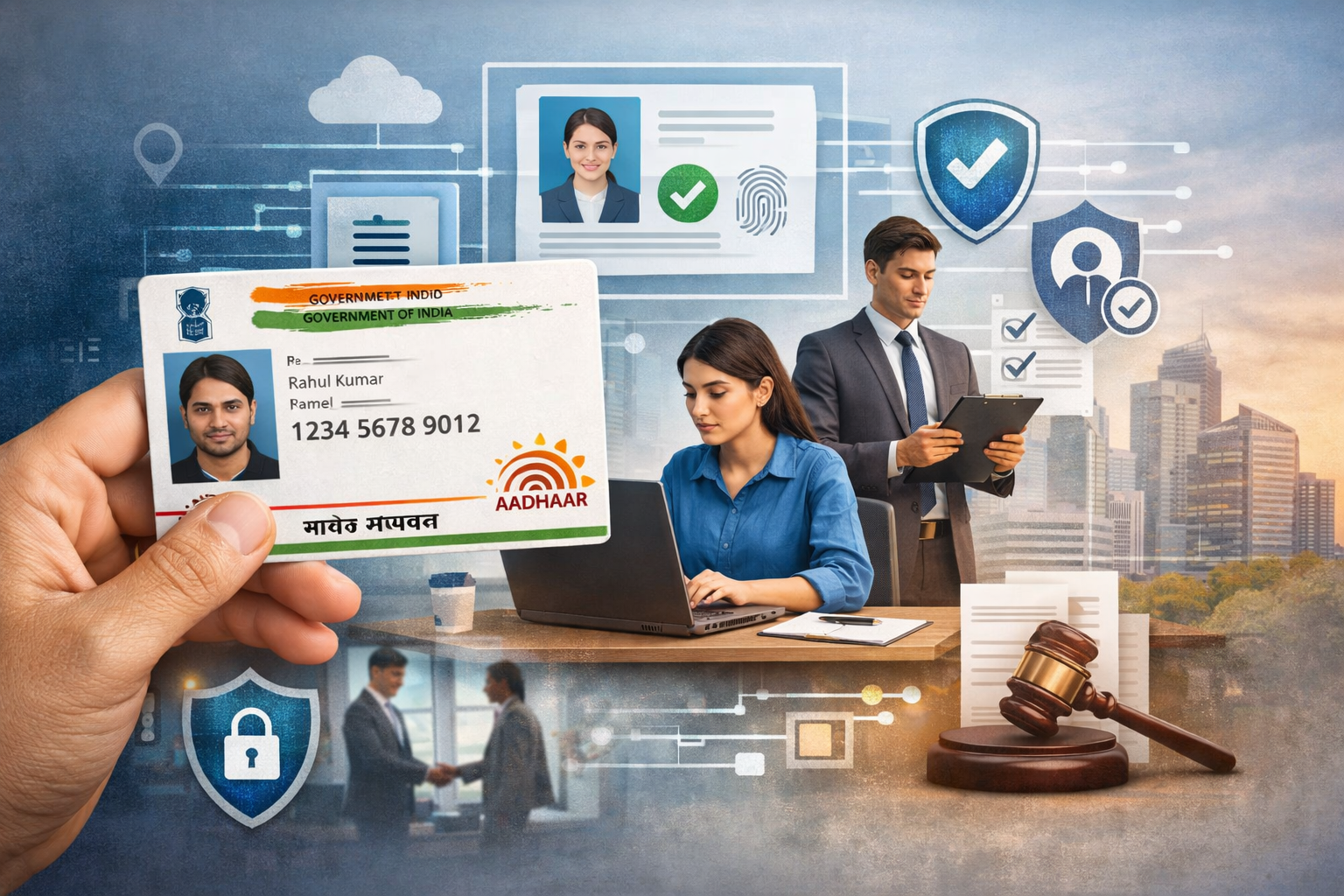
Aadhaar is a unique 12-digit identification number linked to an individual’s biometric and demographic information, including name, date of birth, address, and fingerprints or iris data. Unlike traditional IDs, it is designed to be universally recognized and difficult to duplicate.
In an HR context, Aadhaar-based verification simply means confirming that a candidate’s identity matches the records maintained by UIDAI. Companies do not need to store biometric data themselves. Instead, they use secure verification platforms that send a request to validate the Aadhaar details provided by the candidate.
The process is typically quick and seamless. A candidate submits their Aadhaar number along with basic details, and the system verifies whether the information aligns with official records. If there is a match, the identity is confirmed. If not, the employer can request clarification or additional documentation. This high-level approach allows organizations to strengthen onboarding without turning HR into a technical department.
How Companies Can Use Aadhaar Verification in Onboarding
1. Pre-Employment Identity Validation
Many companies now verify identity before extending a final job offer. This helps them filter out fraudulent applicants early in the hiring cycle. Instead of waiting until the first day of work, HR teams can confirm who the candidate truly is during background screening or offer processing.
This early validation reduces last-minute surprises such as mismatched names, incorrect personal details, or impersonation cases. It also speeds up decision-making, as recruiters can move forward with greater confidence. For candidates, it often means fewer delays and a smoother hiring experience.
2. Digital KYC for Employees
Aadhaar plays a central role in digital KYC, allowing organizations to onboard employees without excessive paperwork. Instead of collecting multiple physical documents, companies can rely on Aadhaar-linked identity validation as a primary proof.
This paperless approach is particularly useful for remote hiring, contract workers, and large-scale recruitment drives. It reduces administrative burden, minimizes storage requirements, and eliminates the risk of misplaced documents. Employees also appreciate the convenience of completing onboarding formalities from anywhere, using their own devices.
3. Background Checks and Compliance
Employee background checks often involve verifying personal details, employment history, and legal standing. Aadhaar verification supports this process by providing a reliable identity baseline. When a person’s identity is clearly established, other checks—such as criminal records or previous employment verification—become more meaningful and accurate.
From a compliance perspective, many industries require strict identity validation for regulatory reasons. Financial institutions, healthcare providers, and government contractors, for example, must demonstrate due diligence in hiring. Integrating Aadhaar-based checks helps organizations align with these expectations while maintaining audit-ready records.
4. Secure Employee Records Management
Once an employee is hired, their identity becomes part of the company’s internal database. Using verified digital identities ensures that employee records are accurate from day one. This reduces errors in payroll, tax filings, and benefits administration.
It also helps prevent duplicate employee records, which can create operational and financial complications. A standardized identity reference makes it easier for HR and IT teams to maintain clean, consistent, and secure personnel data across systems.
Some companies use Aadhaar-linked identity validation as a foundational step in their onboarding workflow. This is the only place in this article where the exact phrase Aadhar Card Verification is used, as part of a broader identity assurance strategy rather than a keyword-driven placement.
Benefits of Using Aadhaar in Employee Onboarding
One of the most visible advantages is speed. Digital identity checks can be completed in minutes rather than days, allowing companies to bring new hires onboard faster. This is especially valuable in competitive industries where delays can lead to losing top talent.
Paperwork reduction is another major benefit. HR teams spend less time collecting, scanning, and filing documents, freeing them to focus on strategic tasks such as employee engagement and workforce planning.
Fraud risk decreases significantly when identity is validated through a trusted national database. Companies are less likely to fall victim to impersonation, fake credentials, or document manipulation.
Better compliance is a natural outcome of structured verification. Organizations can demonstrate that they follow standardized identity checks, which is useful during audits or regulatory reviews.
HR efficiency improves as manual bottlenecks are removed. Recruiters and onboarding specialists can process more candidates with fewer resources, leading to smoother operations.
Finally, there are clear cost savings. Reduced administrative workload, fewer fraud-related losses, and lower reliance on manual verification agencies contribute to long-term financial benefits for businesses.
Data Privacy and Security Considerations
While Aadhaar offers strong identity assurance, its use must be responsible and compliant. Personal data is sensitive, and mishandling it can harm both employees and organizations. Companies must follow Indian data protection principles such as purpose limitation, data minimization, and secure storage.
Aadhaar details should only be collected when genuinely necessary and used strictly for identity verification, not for unrelated profiling or tracking. Access to such data should be restricted to authorized personnel, and systems should be protected with encryption and strong cybersecurity measures.
Employees should be informed about how their data will be used and stored. Transparency builds trust and reduces concerns about misuse. Responsible handling of Aadhaar information is not just a legal obligation; it is a cornerstone of ethical HR practice.
Challenges and Best Practices
Despite its advantages, Aadhaar-based verification is not without concerns. Data breaches, unauthorized access, or misuse of personal information can damage both employees and companies. This makes secure verification infrastructure essential rather than optional.
Organizations should use reputable verification platforms that follow industry security standards. Cheap or unreliable tools may expose sensitive data to unnecessary risk.
Consent-based verification is another critical best practice. Employees must voluntarily agree to share their Aadhaar details for onboarding purposes. Coercion or unclear policies can lead to legal and ethical issues.
Partnering with experienced verification providers helps companies navigate technical, legal, and operational challenges. A reliable partner ensures compliance, security, and seamless integration with existing HR systems.
Conclusion
Aadhaar-based identity checks have reshaped how companies think about employee onboarding in India. What was once a slow, document-heavy process has evolved into a faster, more secure, and more reliable system built on digital trust.
For businesses, the value lies not just in efficiency but in risk reduction, compliance, and data accuracy. For employees, it offers convenience, transparency, and a smoother entry into their new roles.
As digital transformation continues, identity verification will only become more central to workforce management. Companies that adopt responsible, secure, and thoughtful approaches to Aadhaar-based onboarding will be better positioned to build trustworthy, compliant, and future-ready organizations in an increasingly connected India.