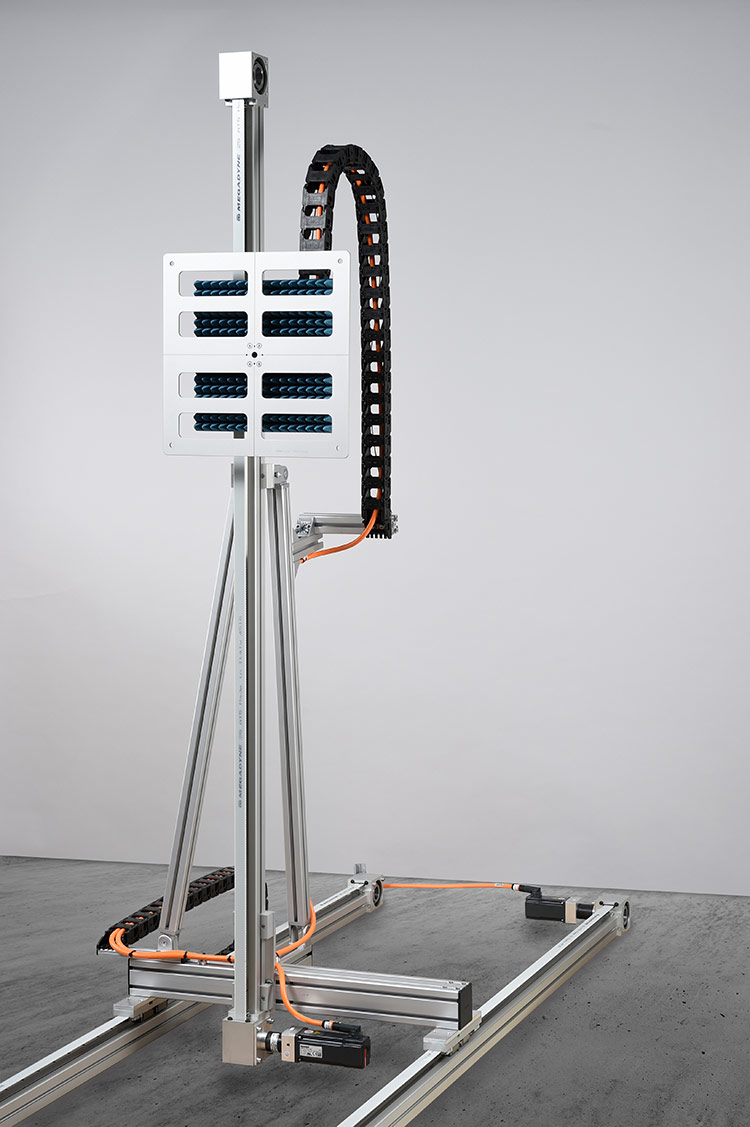
As wireless technologies evolve toward higher frequencies, wider bandwidths, and smarter signal processing, validating real-world performance has become more complex than ever. In 2026, technologies such as Massive MIMO, beamforming, and adaptive antennas are no longer limited to cutting-edge research—they are now standard across 5G, private networks, automotive radar, and emerging 6G trials.
At the center of accurate over-the-air (OTA) validation is the antenna positioning system, a critical component that enables precise, repeatable, and multi-angle measurements. Without controlled antenna movement and positioning, validating beam patterns, spatial diversity, and directional performance would be nearly impossible. As testing requirements grow stricter, antenna positioning has moved from a supporting tool to a foundational element of advanced RF validation.
Key Takeaways
-
Understand how antenna positioning enables accurate MIMO and beamforming validation
-
Learn the challenges labs face when testing advanced antenna technologies
-
Explore key features that matter in modern antenna positioning solutions
-
Discover best practices to optimize OTA test accuracy and repeatability
-
See how positioning systems support future-ready wireless validation
Why MIMO and Beamforming Demand Precision Testing
Modern wireless systems rely heavily on spatial techniques to improve performance. MIMO uses multiple antennas to transmit and receive signals simultaneously, increasing throughput and reliability. Beamforming dynamically steers RF energy toward specific devices, improving coverage and reducing interference.
These technologies introduce one major challenge: performance is no longer uniform in all directions. Radiation patterns change dynamically, and small variations in angle or position can significantly affect results. This makes static or manual measurement approaches unreliable.
To accurately capture these variations, test systems must measure performance across multiple spatial angles with extreme precision. This is where an antenna positioning system becomes essential, enabling controlled antenna movement around the device under test (DUT) while maintaining repeatability.
The Role of Antenna Positioning in OTA Test Environments
In OTA testing, the DUT remains stationary while the measurement antenna moves across predefined positions, elevations, and rotations. This approach simulates real-world device usage more accurately than conducted testing alone.
An advanced antenna positioning system ensures that each measurement point aligns exactly with the intended test angle. For MIMO validation, this precision allows engineers to analyze spatial streams, correlation, and isolation between antenna elements. For beamforming, it enables detailed mapping of beam direction, shape, and side lobes.
Without automated positioning, these tests would require excessive manual effort, increasing test time and introducing human error.
Key Challenges in MIMO and Beamforming Validation
Testing advanced antenna technologies presents several challenges that laboratories must overcome.
One major issue is repeatability. Even small inconsistencies in antenna placement can skew results, making it difficult to compare measurements across test runs. Another challenge is test duration. MIMO and beamforming validation require hundreds or even thousands of measurement points, which is impractical with manual positioning.
Additionally, higher-frequency testing—such as mmWave—demands tighter mechanical tolerances. Any vibration, backlash, or misalignment in the positioning mechanism can degrade measurement accuracy. These challenges highlight why purpose-built positioning systems are now a necessity rather than an option.
Features That Matter in a Modern Antenna Positioning System
Not all positioning solutions are created equal. For MIMO and beamforming validation, certain features are especially important.
High angular accuracy and resolution ensure that beam patterns are captured precisely. Smooth, vibration-free motion prevents signal distortion during measurements. Multi-axis movement allows full spherical or cylindrical scanning, which is critical for advanced OTA test cases.
Automation and software integration are equally important. When the antenna positioning system communicates seamlessly with test instruments and measurement software, it enables synchronized motion and data capture. This not only improves accuracy but also significantly reduces overall test time.
Benefits for Test Labs and Research Institutions
Investing in a robust positioning solution delivers measurable benefits across multiple use cases. Test labs gain higher confidence in compliance and performance validation. Research institutions can conduct repeatable experiments and compare results across different designs or generations.
Automation also reduces operator workload and minimizes human error, freeing engineers to focus on analysis rather than setup. Over time, faster test cycles translate into reduced operational costs and quicker time-to-market for wireless products.
Most importantly, precise positioning enables deeper insight into real-world device behavior—something that is increasingly critical as wireless systems become more adaptive and intelligent.
Best Practices for Selecting and Optimizing Positioning Solutions
When selecting a positioning solution, organizations should start by defining their test requirements. Consider frequency range, DUT size, required angular resolution, and future technology roadmaps. A system that meets today’s needs but lacks scalability may limit long-term value.
Calibration and maintenance should not be overlooked. Regular calibration ensures mechanical accuracy remains within tolerance, especially for high-frequency measurements. Integrating the positioning system early into the test workflow also helps teams develop standardized procedures that improve consistency.
Finally, training operators and documenting test methodologies ensures that positioning accuracy translates into meaningful, repeatable data across teams and locations.
Supporting the Future of Wireless Validation
As wireless standards evolve toward higher antenna counts, smarter beam control, and AI-driven optimization, testing complexity will continue to increase. Positioning systems must keep pace by offering higher precision, faster movement, and deeper software integration.
Looking ahead, antenna positioning will play a growing role not only in validation but also in characterization and optimization during product development. From lab-based R&D to certification and production testing, positioning accuracy will remain a cornerstone of reliable wireless performance.
Frequently Asked Questions
What is an antenna positioning system used for in OTA testing?
It is used to move measurement antennas precisely around a device under test to capture radiation patterns, beam direction, and spatial performance accurately.
Why is antenna positioning important for MIMO validation?
MIMO performance depends on spatial separation and directionality. Precise positioning enables accurate measurement of multiple signal paths and antenna interactions.
How does beamforming testing benefit from automated positioning?
Automated positioning allows detailed beam mapping across many angles, helping engineers validate beam direction, gain, and side lobe performance efficiently.
Can one positioning system support both sub-6 GHz and mmWave testing?
Yes, provided the system offers sufficient mechanical accuracy, stability, and compatibility with high-frequency test environments.
What should labs consider when upgrading positioning systems?
Labs should evaluate accuracy requirements, automation capabilities, software integration, and scalability for future wireless technologies.
Take the Next Step Toward Smarter OTA Validation
As MIMO and beamforming become essential to modern wireless systems, precise antenna positioning is no longer optional—it is foundational. Organizations that invest in advanced positioning solutions gain faster validation cycles, higher measurement confidence, and deeper insight into real-world performance.
With proven expertise in RF testing automation and precision motion systems, Orbis Systems continues to support forward-looking labs and manufacturers with solutions designed for accuracy, scalability, and next-generation wireless validation.