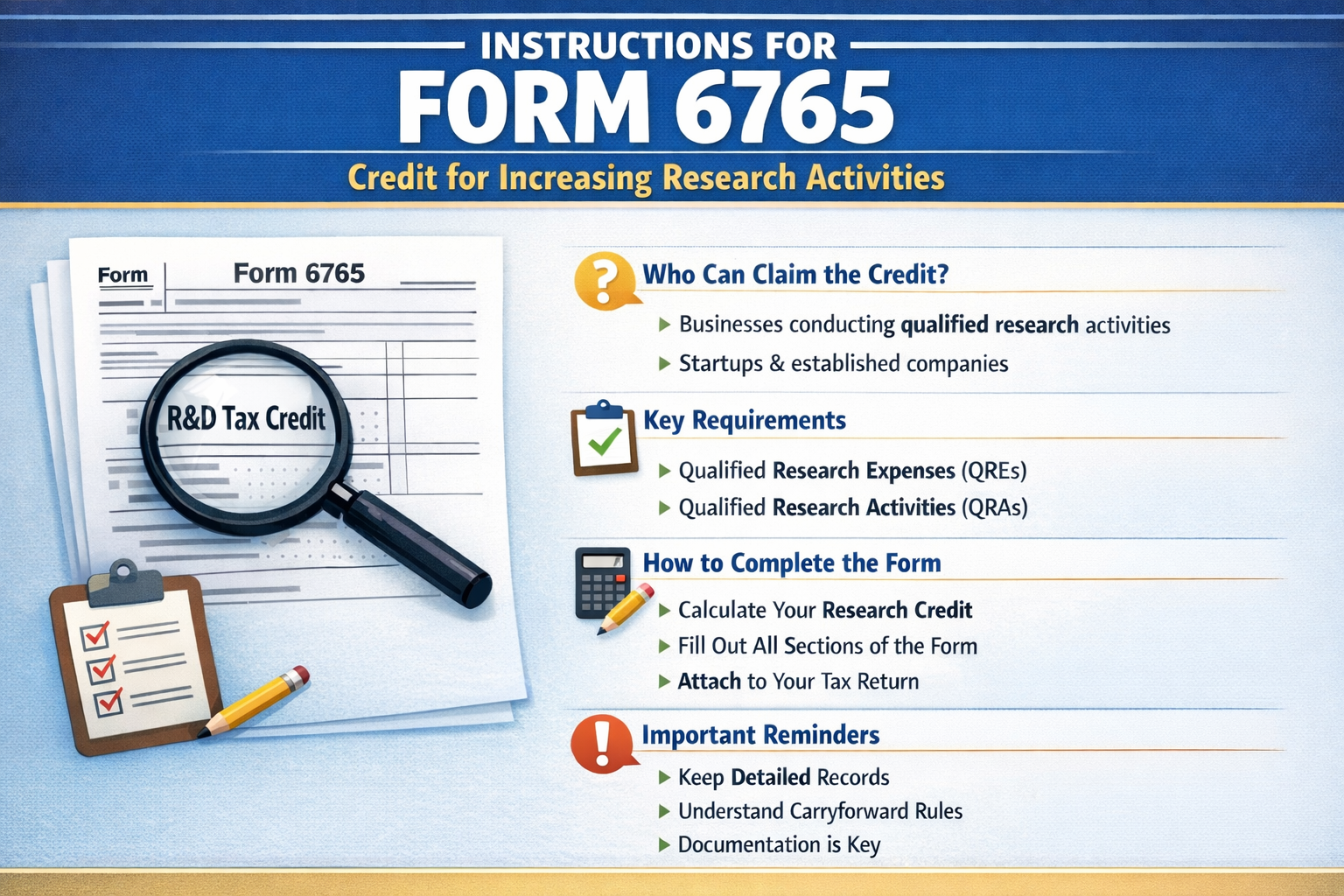
Form 6765 instructions guide businesses on claiming the IRS R&D tax credit, detailing eligibility, qualified research expenses, calculation methods, and proper documentation for accurate filing.
Table of Contents
- Introduction to Form 6765
- What Is Form 6765 Used For?
- Why the R&D Tax Credit Matters in 2026
- Who Qualifies for the R&D Tax Credit?
- What Are Qualified Research Expenses (QREs)?
- Step-by-Step IRS Form 6765 Instructions
- Regular vs ASC Method: Which to Choose
- How to Calculate ASC vs Regular Method
- Can Startups Use Payroll Offset?
- Required Documents for Form 6765
- Form 6765 Instructions 2025 vs 2026 Updates
- Common Filing Mistakes to Avoid
- How Proper Filing Builds IRS Trust
- Booksmerge Insights for Accurate Filing
- Conclusion
- FAQs
Introduction to Form 6765
Innovation is expensive. The IRS knows this, which is why Form 6765 exists. It allows businesses to claim a federal tax credit for research and development expenses, helping them recover part of their investment.
Yet many companies either skip the credit or file it incorrectly. Some fear audits. Others feel overwhelmed by technical tax language. That’s where Booksmerge steps in, offering clear guidance on IRS Form 6765 instructions so businesses can claim what they are entitled to confidently.
What Is Form 6765 Used For?
Form 6765 is used to claim the federal R&D tax credit, designed to reward businesses that invest in innovation.
Businesses can use the credit to:
- Reduce income tax liability
- Offset payroll taxes for eligible startups
- Recover costs for developing or improving products, processes, or software
The IRS defines qualified research as activities intended to eliminate uncertainty and improve functionality, quality, or performance. Even failed experiments can count, so long as they meet IRS standards.
Why the R&D Tax Credit Matters in 2026?
The R&D tax credit remains a powerful incentive. Thousands of businesses miss out due to misunderstanding eligibility or insufficient documentation.
In 2026, the IRS emphasizes clear records and compliance. Companies that follow instructions for Form 6765 benefit by:
- Reducing tax liability
- Protecting cash flow
- Encouraging reinvestment in innovation
This credit isn’t just for tech giants. Manufacturing firms, biotech startups, and even software developers can claim it.
Who Qualifies for the R&D Tax Credit?
Eligibility extends beyond high-tech companies. Businesses that typically qualify include:
- Software development companies
- Manufacturers improving processes or products
- Engineering, architecture, and design firms
- Biotech and medical research startups
To qualify, activities must pass the IRS four-part test:
- Permitted purpose – Improve quality, functionality, or performance
- Eliminate uncertainty – Solve technical challenges
- Process of experimentation – Test, refine, or prototype
- Technological in nature – Based on science or engineering principles
If your company performs experimental development, you likely qualify.
What Are Qualified Research Expenses (QREs)?
QREs are the foundation of IRS Form 6765 instructions. Without them, there is no credit.
Qualified expenses include:
- Wages paid to employees engaged in R&D
- Supplies used directly in research
- Contract research costs, often limited to 65% of total payments
Expenses like marketing, administration, or routine training don’t count. Proper classification and documentation are crucial to avoid audits.
Step-by-Step IRS Form 6765 Instructions
Form 6765 consists of four primary sections:
- Part I: Regular Credit – Uses historical base period data for credit calculation
- Part II: Alternative Simplified Credit (ASC) – Simplifies calculations and reduces recordkeeping
- Part III: Coordination with Other Credits – Ensures proper reporting alongside additional tax credits
- Part IV: Payroll Tax Offset – Allows eligible startups to apply the credit against payroll taxes
Following these instructions ensures accuracy and compliance, preventing costly mistakes.
Regular vs ASC Method: Which to Choose?
Businesses face a choice between two calculation methods:
- Regular Credit Method – Requires detailed historical data to calculate credit based on past research spending. Suitable for established companies with long records.
- Alternative Simplified Credit (ASC) – Uses a three-year average of prior expenses, reducing documentation requirements. Ideal for startups and small businesses.
Most companies in 2026 prefer ASC due to simplicity and reduced audit risk.
How to Calculate ASC vs Regular Method
ASC Method:
- Credit = 14% of QREs above 50% of the prior three-year average
Regular Method:
- Requires historical QREs and gross receipts to calculate a fixed base percentage
Choosing the right method ensures compliance and maximizes the claim.
Can Startups Use Payroll Offset?
Yes. Eligible small businesses can apply up to $500,000 of R&D credits against employer payroll taxes.
Requirements include:
- Gross receipts under $5 million
- No gross receipts prior to the five-year window
This offset helps startups maintain cash flow while funding innovation.
Required Documents for Form 6765
The IRS requires documentation to support your claim, not guesses. Essential records include:
- Payroll and W-2 reports
- Time-tracking logs for R&D activities
- Expense ledgers for supplies and contract research
- Project descriptions, test notes, and technical documentation
Strong documentation improves compliance and audit defense. For additional financial literacy insights, check this resource:Financial Literacy Statistics
Form 6765 Instructions 2025 vs 2026 Updates
While the structure remains mostly unchanged, the IRS in 2026 emphasizes:
- Project-level documentation
- Clear linkage between QREs and research activities
- Detailed explanations for software development projects
Following the latest instructions ensures you stay compliant and avoid delays or rejections.
Common Filing Mistakes to Avoid
Even experienced companies make errors:
- Including non-R&D wages
- Using vague descriptions of projects
- Unsupported estimates
- Filing without contemporaneous documentation
Accuracy and clarity reduce audit risk and maximize your refund potential.
How Proper Filing Builds IRS Trust?
Accurate filings signal professionalism to the IRS and other stakeholders. Benefits include:
- Lower audit exposure
- Better long-term tax planning
- Increased credibility with lenders and investors
Trust grows when your documentation matches reality.
Booksmerge Insights for Accurate Filing
Booksmerge helps businesses navigate form 6765 instructions 2025-2026 with clarity and precision.
Our services include:
- QRE identification and classification
- ASC vs regular method analysis
- Documentation preparation and review
- Payroll offset optimization
For guidance, call +1-866-513-4656 and work with experts who prioritize accuracy, compliance, and real results.
Conclusion
Form 6765 remains a valuable tool for businesses of all sizes in 2026. Filing correctly, documenting properly, and choosing the right method ensures you claim the credit confidently while avoiding audits.
Innovation deserves support, and the IRS agrees. Following instructions for Form 6765 protects your business and maximizes savings.
Frequently Asked Questions
1. What is Form 6765 used for?
Form 6765 allows businesses to claim the federal R&D tax credit for qualified research activities and expenses.
2. Who qualifies for R&D tax credit?
Businesses that conduct experimental development, testing, or technical improvement may qualify, regardless of size or industry.
3. What are QREs?
QREs are qualified research expenses, including wages, supplies, and contract research costs tied directly to R&D projects.
4. How to calculate ASC vs regular method?
The ASC method uses a three-year rolling average of QREs, while the regular method relies on historical base period data for calculation.
5. What documents are required?
Payroll records, expense reports, technical documentation, project descriptions, and contemporaneous notes support a valid Form 6765 claim.
6. Can startups use payroll offset?
Yes. Eligible small businesses can apply up to $500,000 of R&D credits against payroll taxes to preserve cash flow.
7. What changed in 2025 and continues in 2026?
The IRS increased scrutiny on documentation, requiring project-level explanations and detailed linkage between QREs and research activities.
Read Also: Form 6765 Instructions
Need help with IRS Form 6765 instructions? Booksmerge is ready to guide you. Call +1-866-513-4656 today.