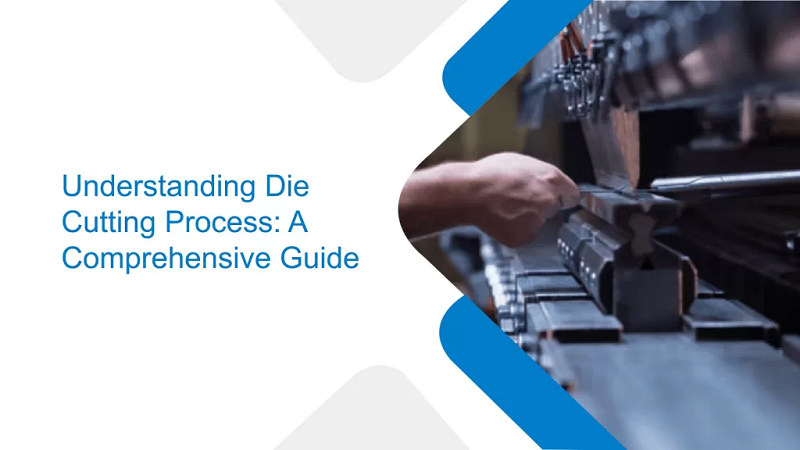
The Die Cutting Process is a fundamental manufacturing technique widely used to produce precise, uniform, and repeatable components across multiple industries. From packaging and automotive parts to electronics and industrial assemblies, die cutting manufacturing plays a critical role in ensuring efficiency, accuracy, and scalability.
This beginner-friendly guide by Eigen Engineering explains the die cutting process step by step, outlines essential tools, and highlights its industrial applications to help manufacturers and engineers understand this important production method.
What Is a Die in the Metal Industry?
A die in manufacturing is a specially designed metal tool engineered to cut, shape, or form materials using controlled pressure. Unlike manual cutting methods, the die cutting process relies on machines that apply consistent force, ensuring clean edges and dimensional accuracy.
The die has sharp or sharpened edges that cut through the material deposited beneath it. Once pressure is applied, the material is cut into a predefined shape with minimal variation, making die cutting manufacturing ideal for high-volume production.
What is Die Cutting Process?
The Die Cutting Process is a manufacturing method in which a specially designed die is used to cut, shape, or form materials under controlled pressure. Unlike manual cutting, the Die Cutting Process ensures uniformity, speed, and precision, making it suitable for both low-volume prototypes and high-volume production.
In die cutting manufacturing, materials such as paper, cardboard, rubber, plastics, foams, metals, and fabrics can be processed depending on machine capability and die design.
Industries rely on the die-cutting process because it ensures:
- High repeatability
- Minimal material waste
- Faster production cycles
- Uniform output quality
These advantages make die cutting essential in both light and heavy manufacturing environments.
Step 1: Die Design and Preparation
The process begins with designing the die according to the required shape and tolerances. In die cutting manufacturing, this step determines the accuracy of the final output.
Step 2: Material Selection
The appropriate material is chosen based on application requirements. Common die cutting uses include cutting gaskets, insulation layers, labels, seals, and protective components.
Step 3: Machine Setup
The die is mounted into the machine, and pressure settings are adjusted based on material thickness and hardness. Proper alignment ensures consistent cutting.
Step 4: Die Placement
The die is positioned with its cutting edge facing the material. Accurate placement prevents uneven cuts and tool damage.
Step 5: Pressure Application
The machine applies uniform pressure, allowing the die to penetrate and cut through the material cleanly. This is the core stage of the die cutting process.
Step 6: Material Removal
Once cutting is complete, excess material is removed, leaving behind the finished component with smooth edges and accurate dimensions.
Step 7: Inspection and Quality Control
Each batch is inspected to ensure conformity with design specifications, which is essential in precision-driven die cutting manufacturing.
Types of Dies Used in the Metal Industry
Different projects require different die designs. Understanding the main types of dies helps beginners choose the right solution for their needs.
Blank Die: Blank Dies are used for blanking (the process of cutting flat-sheet metal into flat shaped pieces), where the deleted part(s) become the Blank and the resulting flat piece become the Finished Part.
Blank Die applications are very common within the automotive industry and are typically found in other manufactured industrial-type components such as bolts, washers and brackets.
Punch Die: Punching Die is similar to Blank Die as it removes material and results in the blank (the scrap in this case). Punch Die Operations create holes, slots and cuts in flat sheets of metal. Punch Die applications are found in Ventilation, Control Panels and Metal Housing markets.
Progressive Die: Progressive Dies create several different Family-Punches within the shape that will be used as the Finished Part when the metal sheet is pressed through all the stations in the same operation.
Progressive Die applications are most commonly used in high-volume production environments where both speed and consistency are of utmost importance. Applications for Progressive Die include Automotive, Electronics Manufacturing and Appliance Manufacturing.
Compound Die: Compound Dies replace the need for two separate machine operations (e.g. Punching and Cutting). With the Compound Die, two separate press operations (Punch and Cut) can be done in the same press operation.
Common Die Cutting Uses Across Industries
The versatility of the die cutting process enables its use in multiple sectors, including:
- Automotive: Gaskets, insulation pads, seals.
- Packaging: Cartons, inserts, labels.
- Electronics: Insulating films, conductive layers.
- Medical: Adhesive components, protective coverings.
- Industrial Equipment: Rubber parts, foam padding.
These die-cutting uses demonstrate why the process is indispensable for scalable manufacturing operations.
Advantages of Die-Cutting Manufacturing
For beginners, it is important to understand why the die-cutting process is widely adopted:
- High precision and repeatability.
- Efficient production for large volumes.
- Minimal material waste.
- Compatibility with multiple materials.
- Scalable for simple and complex designs.
These advantages make die-cutting manufacturing a preferred solution for engineered components.
Common Mistakes Beginners Should Avoid
New operators in die cutting manufacturing often encounter avoidable errors:
- Using incorrect material thickness
- Improper die alignment
- Applying excessive pressure
- Ignoring machine maintenance
Avoiding these issues ensures smoother operations and prolongs the lifespan of die-cutting tools.
Why Choose Eigen Engineering for Die Cutting Solutions?
At Eigen Engineering, precision, quality, and reliability define every stage of the die-cutting process. With advanced die-cutting tools, skilled engineering expertise, and strict quality control, Eigen Engineering delivers customised solutions tailored to diverse industrial requirements.
Whether for small-batch components or high-volume die cutting manufacturing, Eigen Engineering ensures consistent performance and superior results.
In Conclusion, Die Cutting Process is a foundational manufacturing technique that combines engineered tools, controlled force, and repeatable operations to deliver precise components at scale. By understanding the die in manufacturing, selecting appropriate die cutting tools, following structured steps in the die cutting process, and recognising key die cutting uses, beginners can appreciate both the simplicity and technical depth of this method.
At Eigen Engineering, die cutting manufacturing is executed with a focus on accuracy, reliability, and process optimisation, ensuring that every Die Cutting Process delivers consistent value across industrial applications.