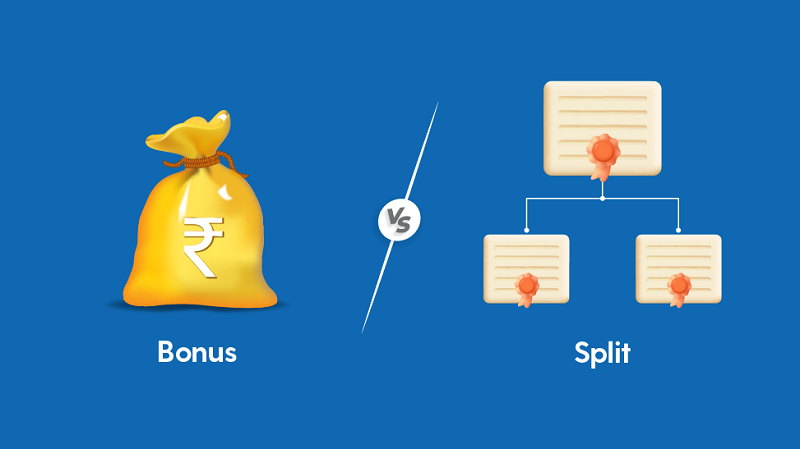
Corporate actions are decisions taken by a company that change its share structure or affect shareholders. Two common examples are bonus shares and stock split announcements.
Both increase the number of shares you hold, but they serve different purposes and are treated differently in company accounts. Bonus Shares are issued from a company’s reserves, while a stock split reduces the face value of existing shares.
Understanding bonus shares and stock splits helps interpret company updates and avoid confusion.
What Are Corporate Actions
Corporate actions are events initiated by a company that directly impact its securities and shareholders:
- Definition of corporate actions: These are decisions approved by the board and shareholders that alter share capital, ownership structure, or entitlements.
- Why companies announce them: Actions may aim to improve liquidity, reward shareholders, or adjust the market price of shares.
- Impact on investors: Shareholding quantity may change, but ownership percentage usually remains the same.
Understanding Bonus Shares
Bonus issues are additional shares issued to existing shareholders without any cash payment:
- Meaning of bonus shares: Companies distribute extra shares in a fixed ratio such as 1:1 or 2:1 based on current holdings.
- Source of issuance: Bonus issues are offered from accumulated reserves or retained earnings.
- Eligibility date: Shareholders on record as of the record date receive these shares.
Why Companies Issue Bonus Shares
Companies use bonus issues as a non-cash method of rewarding shareholders:
- Capitalising reserves: Excess reserves are converted into share capital without affecting cash flows.
- Signalling confidence: A bonus issue may reflect management confidence in long-term growth.
- Improving affordability: Increased share count reduces the per-share price, improving market participation.
Impact of Bonus Issues on Share Price
Bonus issues change the number of shares but not the overall investment value:
- Price adjustment: Share price adjusts downward proportionally after the bonus issue.
- Unchanged market value: Total investment value remains the same immediately after the adjustment.
- No dilution of ownership: Shareholders retain the same percentage ownership.
Understanding Stock Split
A stock split divides existing shares into multiple shares with a lower face value:
- Meaning of stock split: Each existing share is split into more shares, such as a 1:5 split.
- Change in face value: The nominal value per share reduces, while share capital remains unchanged.
- No use of reserves: Unlike bonus shares, no reserves are capitalised.
Why Companies Announce Stock Splits
Stock splits are often used to adjust trading dynamics rather than distribute value:
- Enhancing liquidity: Lower share prices can increase trading volumes.
- Broadening investor base: Smaller investors may find split shares more affordable.
- Aligning with market range: Companies may prefer their stock to trade within a specific price band.
Impact of Stock Split on Share Price
Stock splits affect the unit price but not shareholder wealth:
- Proportional price reduction: Share price adjusts proportionally to the split ratio.
- Constant market capitalisation: The company’s total market value remains unchanged.
- No change in reserves: Financial statements reflect only a face value adjustment.
Bonus Shares and Stock Split Compared
Both actions increase share count, but their structure and intent differ:
- Source of increase: Bonus issues come from reserves, while stock splits alter face value.
- Accounting treatment: Bonus issues increase share capital, stock splits do not.
- Shareholder perception: Bonus issues are often seen as rewards, stock splits as liquidity tools.
Effect on Shareholder Wealth
Neither action creates immediate financial gain or loss:
- No instant profit: Market value stays constant immediately after adjustment.
- Psychological impact: Lower prices may attract interest but do not change fundamentals.
- Long-term value: Returns depend on company performance, not corporate actions.
Tax Treatment Overview
Tax implications arise only when shares are sold:
- No tax on receipt: Bonus shares and stock split shares are not taxed at allotment.
- Capital gains calculation: Cost of acquisition is adjusted based on regulatory rules.
- Holding period continuity: Original acquisition date usually applies for taxation purposes.
Common Misunderstandings Around These Actions
Misinterpretation often leads to unrealistic expectations:
- Not free income: Bonus issues are not additional wealth.
- Not price appreciation: Stock splits do not increase intrinsic value.
- Market reaction varies: Short-term movements depend on sentiment, not structure alone.
Conclusion
Bonus shares and stock split announcements are structural changes which are made to improve liquidity, optimise share pricing, or adjust capital structure. While both increase the number of shares held by investors, they do not change ownership value at the time of execution. Understanding how these actions work helps investors read announcements clearly and focus on long-term fundamentals rather than short-term price changes.