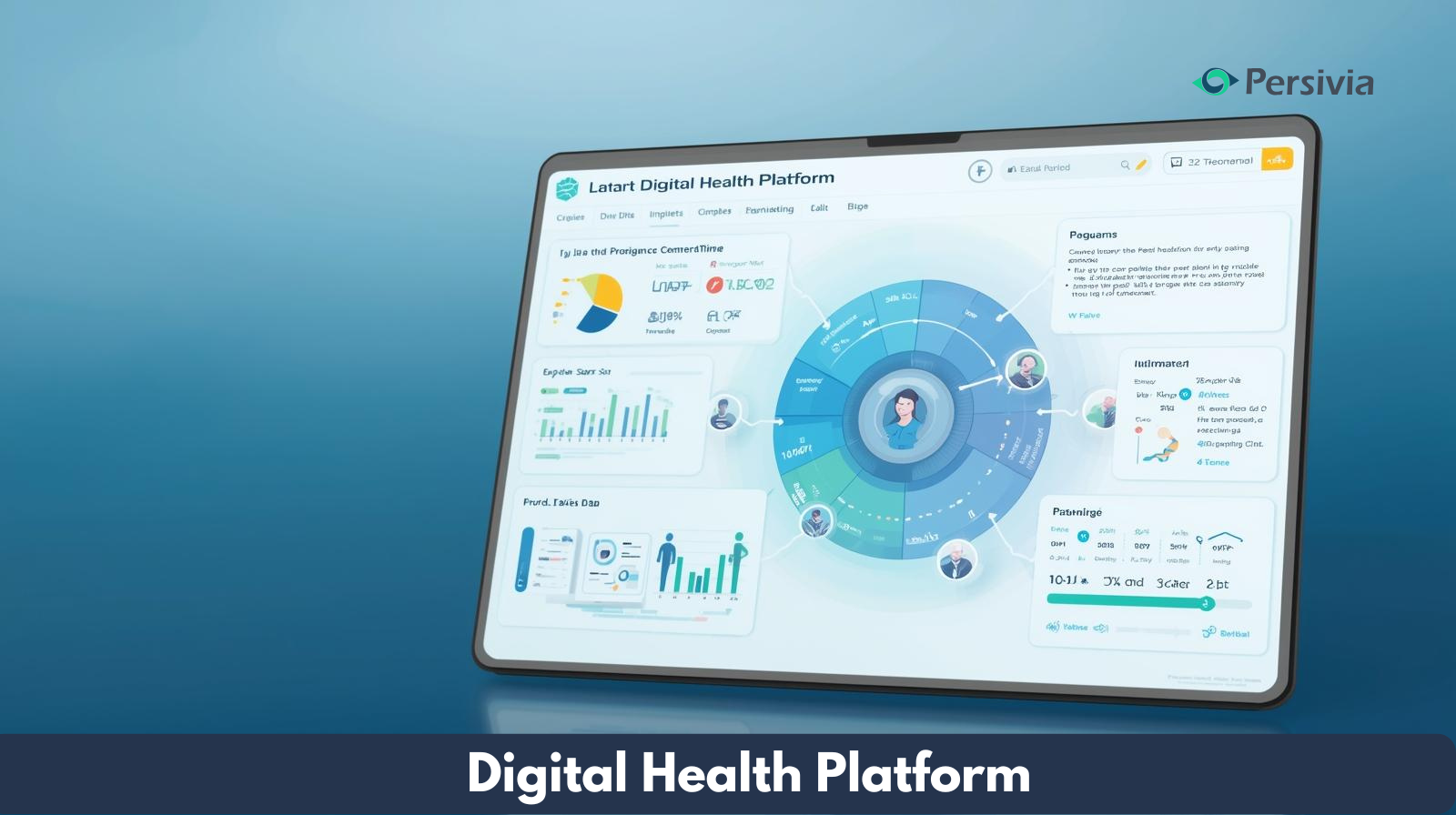
Value-based care requires technology that links broken data, reveals actionable insights, and assists clinical teams in areas where decisions count the most. A Digital Health Platform reduces fragmentation by bringing clinical records, claims data, and quality measures into one workflow that care managers and physicians can access easily.
The platform you adopt defines all aspects of daily care coordination to annual quality reporting. Choose wrong, and you end up with adoption failures, quality bonuses dodged, and frustrated employees. Choose the right one, and you open up measurable gains in patient care, operational efficiency, and financial performance.
What Makes a Digital Health Platform Essential Today?
Healthcare organizations are faced with numerous EHRs, claims systems, and specialty applications that lack communication with each other. The care managers spend hours moving from one screen to another to assemble the history of the patients. Many quality teams still track HEDIS measures manually in spreadsheets. Doctors often miss important care notifications because messages get buried in their inbox.
A comprehensive platform helps create a single source of patient data across systems. It links all systems within your environment, automatically normalises the data, and provides insights where clinical decisions are taken.
Core Platform Capabilities
Healthcare AI processes raw clinical and claims data and turns it into insights that teams can act on. The platform handles technical complexity behind the scenes:
- Bidirectional EHR connectivity for seamless data flow
- Automated quality reporting for STAR ratings, HEDIS, and HCC coding
- Embedded care pathways that guide interventions
- Real-time analytics dashboards for population health management
- Point-of-care tools that show patient risks, gaps, and recommendations during the visit
- Risk stratification based on combined clinical and claims inputs
- Predictive models estimate the likelihood of ED visits or admissions
The Financial Impact
Platforms deliver returns through multiple channels:
- Quality improvements drive STAR rating increases and HEDIS bonus payments
- Better utilization management reduces unnecessary ED visits and hospital admissions
- Automated workflows free staff from manual tasks
- Shared savings and cost avoidance create direct financial gains
Fact: Prime Healthcare has reported $34 million in savings through improved care coordination and utilization control supported by Persivia.
Understanding Your Organization’s Requirements
Start by documenting current pain points rather than creating wish lists of features. Map your technology landscape completely and calculate what you spend on maintaining fragmented systems. Many organizations learn that maintaining several point solutions often costs more than a unified platform.
Defining Success Metrics
Set measurable goals before talking to vendors:
- Clinical quality: Measure rates, care gap closure, outcome improvements
- Financial performance: Shared savings, quality bonuses, cost avoidance
- Operational efficiency: Staff productivity, provider satisfaction, workflow time
- User adoption: Login frequency, feature utilization, staff feedback
Remember that platforms fail when clinicians reject them, even if the administrative features are strong.
Identifying Stakeholder Needs
Different users need different capabilities:
- Care managers require comprehensive patient views with embedded care pathways
- Physicians want actionable insights delivered in seconds, not minutes of clicking
- Quality teams need automated measure tracking, eliminating manual chart reviews
- Executive leadership demands financial analytics showing ROI
- IT departments want reliable infrastructure without maintenance headaches
Survey each group to understand their specific requirements and frustrations with current systems.
Key Features That Separate Basic Systems from Comprehensive Solutions
Technology vendors all claim comprehensive capabilities. Real differentiation emerges in data integration depth, clinical intelligence, and workflow automation effectiveness. Basic systems connect to only a few EHRs, while comprehensive platforms support far broader integration across multiple data sources.
Data Integration and Interoperability
The architecture of a digital health platform determines how well it can integrate data from diverse systems. Modern platforms use flexible data fabrics with metadata catalogs that connect disparate information sources.
Key integration capabilities:
- Unlimited source connectivity (EHRs, labs, imaging, HIEs, social services)
- AI-supported record matching and terminology standardization to reduce duplication and inconsistencies
- Automated data normalization without manual intervention
- Real-time bidirectional data flow with major EHR systems
- Proven scalability handling millions of patient records
Clinical Intelligence and Analytics
Clinical intelligence is applied through effective platforms by identifying patients at risk, anticipating future use, and suggesting evidence-based interventions.
Essential analytics capabilities:
- Multi-methodology risk stratification (claims-based, clinical, hybrid models)
- Predictive modeling for admissions, readmissions, and ED utilization
- Automated quality measure tracking with real-time gap identification
- Population segmentation for targeted intervention programs
- Critical event alerts notify care teams so they can respond promptly
Workflow Automation and Point-of-Care Tools
Manual processes don’t scale when managing thousands of patients. Platforms must automate:
- Patient assignment based on risk scores and program criteria
- Outreach campaign triggers when care gaps appear
- Documentation workflows with templates aligned to regulatory requirements
- Secure messaging connecting care teams across organizations
- Task management, ensuring intervention follow-through
Evaluating Vendor Capabilities and Track Record
Marketing materials can overstate capabilities, so due diligence is essential to confirm real performance. Focus on verified outcomes, technical architecture, and implementation experience rather than feature checklists. Vendors need deep healthcare expertise spanning multiple regulatory cycles and payment model transitions.
Client Results and Case Studies
Request detailed case studies with specific, verifiable metrics. Look for documented outcomes across quality improvement, financial performance, operational efficiency, and user adoption.
Strong vendor results include:
- Mount Nittany Health achieved outstanding MIPS results through comprehensive quality tracking
- Iowa Department of Public Health updated its system for COVID-19 reporting in 30 minutes
- Samaritan Medical Center maintains audit-ready accuracy in data mapping
- PMC deployed from contract signing to production in under 30 days
Request the vendors to provide references that can be contacted. Talk to care managers, quality directors, and IT leaders to get an indication of real-life experiences.
Technology Architecture and Scalability
Legacy systems often struggle to meet modern data and performance requirements. Cloud-native platforms can scale easily as data volume grows.
Essential technical requirements:
- Flexible architecture supporting customization without extensive coding
- Open APIs enabling third-party integrations
- Security certifications (HITRUST, SOC 2, HIPAA compliance)
- Proven uptime and disaster recovery capabilities
- Ability to serve millions of patient records across hundreds of hospitals
Ask about their largest implementations and average system uptime to verify scalability claims.
Implementation Strategy and Organizational Readiness
Depending on the platform architecture and experience of any vendor, implementation can take weeks to years. Fast implementations require ready-made templates, automated data mapping, and teams with strong healthcare expertise.
User Training and Adoption
Technology fails when users reject it. Care managers should be able to get comfortable with the platform within a short training period.
Effective adoption strategies:
- Role-based training addressing specific user needs
- Champions within departments who drive usage and answer questions
- Ongoing support through multiple channels (phone, email, portal)
- Regular feedback loops to address concerns quickly
- Celebration of early wins to build momentum
Change Management Considerations
New platforms disrupt established patterns. Address resistance through:
- Transparent communication about current pain points and platform benefits
- End-user involvement in configuration decisions
- Executive sponsorship to overcome organizational inertia
- Adoption metrics tracking with quick intervention when usage lags
Frontline staff acceptance matters more than executive enthusiasm since they use the system daily.
Financial Considerations and ROI Assessment
The pricing of platforms is diverse among vendors. Add up all the costs of ownership, such as software license, implementation services, data integration work, training support, maintenance costs, and internal IT resources. Compare to existing expenditure in independent population health, care management, and quality reporting systems.
Measuring Return on Investment
ROI comes from direct financial returns and indirect benefits:
- Direct returns: Shared savings, quality bonuses, avoided penalties
- Indirect benefits: Staff productivity, reduced IT overhead, improved provider retention
- Quality improvements: Typically visible within 6-12 months
- Financial savings: Usually achieved within 12-24 months
- Operational efficiency: Often realized within 3-6 months
Ensuring Long-Term Success
Your vendor relationship extends far beyond implementation. Select partners who believe in long-term success and have demonstrated account management support models, responsiveness, and forward-looking problem resolutions. Massachusetts Department of Public Health has been in a relationship with its platform for 15 years due to stability, flexibility, and great support from vendors.
Platform Innovation and Updates
Healthcare technology evolves rapidly. Platforms must keep pace with regulatory requirements, clinical evidence, and technological advances.
Innovation requirements:
- Regular updates without disrupting operations or requiring extensive retesting
- Active investment in AI development and enhancement
- Participation in standards initiatives and interoperability programs
- Collaboration with leading healthcare organizations on emerging use cases
- Roadmaps aligned with industry trends toward automation and predictive analytics
Vendors should provide clear visibility into their development priorities and release schedules.
Making the Final Selection
Conduct demonstrations using your actual use cases and sample data. Generic demos showcase features but don’t prove capabilities with your workflows. Bring end users whose feedback matters most since they’ll use the system daily.
Selection process steps:
- Request demos with your specific scenarios and data
- Check references beyond vendor-provided contacts
- Ask about implementation challenges and support responsiveness
- Contact organizations similar to yours in size and payment models
- Negotiate contract terms addressing timelines and performance guarantees
- Engage legal counsel familiar with healthcare technology agreements
Organizations similar to yours provide the most relevant insights into actual platform performance and vendor reliability.
Takeaway
The right platform strengthens value-based care performance by improving quality outcomes, financial results, and staff satisfaction. As a success, capability analysis, evaluation of the vendor, and realistic planning of the implementation are crucial. Companies that select holistic and established solutions position themselves to succeed as the healthcare system turns towards value-based payment models and population health responsibility.
Persivia offers CareSpace®, an AI-driven Digital Health Platform built for full population health management, unified data, and coordinated care. With two decades of experience, the platform supports millions of patient records across hundreds of hospitals and delivers measurable results, including a 65% drop in readmissions and significant cost savings.
FAQs
- How long does it typically take to implement a digital health platform?
Implementation timelines vary based on platform architecture and organizational complexity. Many organizations go live in 30–60 days using pre-built workflows and automated data mapping, while highly customized deployments may take several months.
- What kind of ROI should we expect from platform investment?
Organizations often see positive ROI within 12–24 months through shared savings, quality bonuses, reduced readmissions, and improved operational efficiency. Many report millions in documented savings.
- Do we need extensive IT resources to maintain a digital health platform?
No, cloud-based platforms with strong vendor support require minimal internal IT involvement. Vendors manage updates, security, hosting, and infrastructure, allowing teams to focus on clinical and operational improvement.
- How do we ensure care teams will actually use the new platform?
Successful adoption depends on seamless workflow integration. Platforms with intuitive interfaces, point-of-care EHR embedding, rapid training programs, and role-specific tools drive strong and sustained user engagement.