For the better part of a decade, businesses have been obsessed with a single word: Efficiency. We bought the bots, we mapped the workflows, and we programmed every “If-This-Then-That” scenario we could imagine. For a while, it worked. The “train” of traditional automation stayed on the tracks, moving data from point A to point B with robotic precision.
But then, the world got messy.
In 2026, we are hitting what many experts call the “Automation Wall.” This is the point where traditional, rule-based systems stop being helpful and start becoming a maintenance nightmare. If you’ve ever had a workflow collapse because a client sent a photo of a document instead of a typed PDF, you’ve hit that wall.
The shift we are seeing now isn’t just a faster version of the old tools. It is a fundamental evolution from Task Execution to Strategic Intelligence.
The Era of “Rigid” Automation: Why It’s Faltering
Traditional automation—often referred to as Robotic Process Automation (RPA)—is deterministic. It is fast, but it is effectively “blind.” It succeeds only when the environment is perfectly controlled. It thrives on stability, rule-based logic, and predictable data fields.
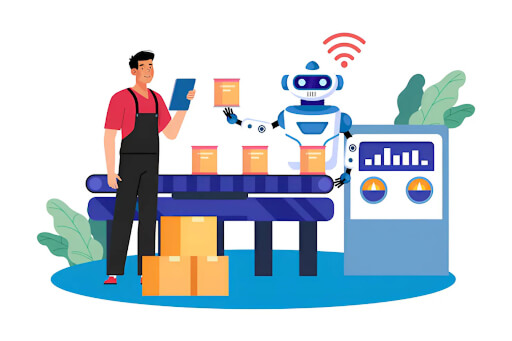
Think of traditional automation like a factory assembly line. It can put a cap on a bottle 10,000 times an hour without a mistake. But if the bottle arrives slightly tilted, or if the cap is a different color, the machine doesn’t know how to “think.” It simply stops, throws an error, and waits for a human to fix it.
In a modern business environment, “tilted bottles” are everywhere. Ambiguous customer emails, variable invoice layouts, and shifting market conditions are the new normal. When you try to force these variables into a rigid, rules-based system, you end up with “Automation Theater,” a system that looks like it’s working on a dashboard, but requires a massive “hidden” team of humans to manage the exceptions manually.
Enter AI-Driven Automation: The Adaptive Leap
The difference between AI-driven automation and the old guard is the ability to interpret.
While traditional tools “execute,” AI-driven systems “decide.” By layering machine learning, Natural Language Processing (NLP), and computer vision onto standard workflows, the system gains a digital “nervous system.” It can extract meaning from an angry customer email, recognize patterns in fraud signals, and—most importantly—improve over time.
This “adaptive” quality is the game-changer. In a traditional setup, if a process changes, a developer must manually rewrite the code. In an AI-driven environment, the system uses feedback loops. When a human corrects a bot’s decision, the model learns. The system you have on Day 365 is significantly smarter than the one you deployed on Day 1.
The Hidden Gains: Moving Beyond “Faster Clicks”
When we talk about automation, we usually talk about saving time. But the most valuable gains in the 2026 landscape aren’t about speed; they are about Decision Augmentation.
The biggest “lift” for a company today comes from better routing and prioritization. Imagine a service ticket system. A traditional bot might route a ticket based on a keyword like “refund.” An AI-driven system, however, analyzes the sentiment. It detects that this particular customer is a long-term VIP who sounds frustrated and might be on the verge of canceling. It doesn’t just route the ticket; it escalates it to a senior manager immediately.
This reduces “operational noise.” It stops the “rework loops” that occur when bots make binary mistakes. By focusing on the outcome rather than just the task, companies are finding they can achieve more with smaller, more specialized teams.
Risk as a Modern Engineering Requirement
As systems become more autonomous, the conversation around risk has changed. It is no longer a “paperwork” problem for the legal department; it is a core engineering requirement.
According to the World Economic Forum, the structural labor-market transformation will impact nearly 22% of jobs by 2030. This isn’t just a story of displacement; it’s a story of evolution. As we delegate more decisions to AI, we must build “guardrails” that keep these systems production-ready.
High-performing organizations are now adopting frameworks like the NIST AI Risk Management Framework. They are focusing on:
- Observability: Ensuring we can explain why an AI made a specific decision.
- Drift Monitoring: Detecting when a model’s accuracy begins to fade because the real-world data has changed.
- Human-in-the-Loop: Designing “kill switches” and escalation points for high-impact decisions, such as financial approvals or security overrides.
How to Start the Transition (Without the Chaos)
The mistake many leaders make is trying to “boil the ocean”—attempting to automate every complex process at once. This leads to high costs and low ROI. The most successful rollouts follow a phased approach:
- Map the Mess: Use process mining to find the real bottlenecks. Don’t automate what you haven’t optimized.
- Introduce Intelligence in Slices: Start with document classification or intent recognition. Let the AI suggest the answer, but let a human click “send.”
- Instrument for Visibility: Ensure every automated decision is logged. If you can’t measure the error rate, you can’t improve the model.
Finding the Right Partner for the Journey
Building a digital nervous system is complex. It requires a blend of data foundations, MLOps, and custom software integration. This is where specialized expertise becomes vital.
For companies looking to bridge this gap, partners like ViitorCloud have become essential. They provide the “glue” that connects custom AI solutions with existing cloud infrastructure, helping businesses move away from fragmented bots and toward end-to-end orchestration.
Whether it’s digital transformation consulting or custom AI integration, the goal is to create a repeatable capability rather than a one-off experiment.
The Bottom Line
In 2026, automation is no longer a “set it and forget it” tool. It is a living capability. The companies that thrive won’t be the ones with the most bots; they will be the ones with the most adaptive systems.