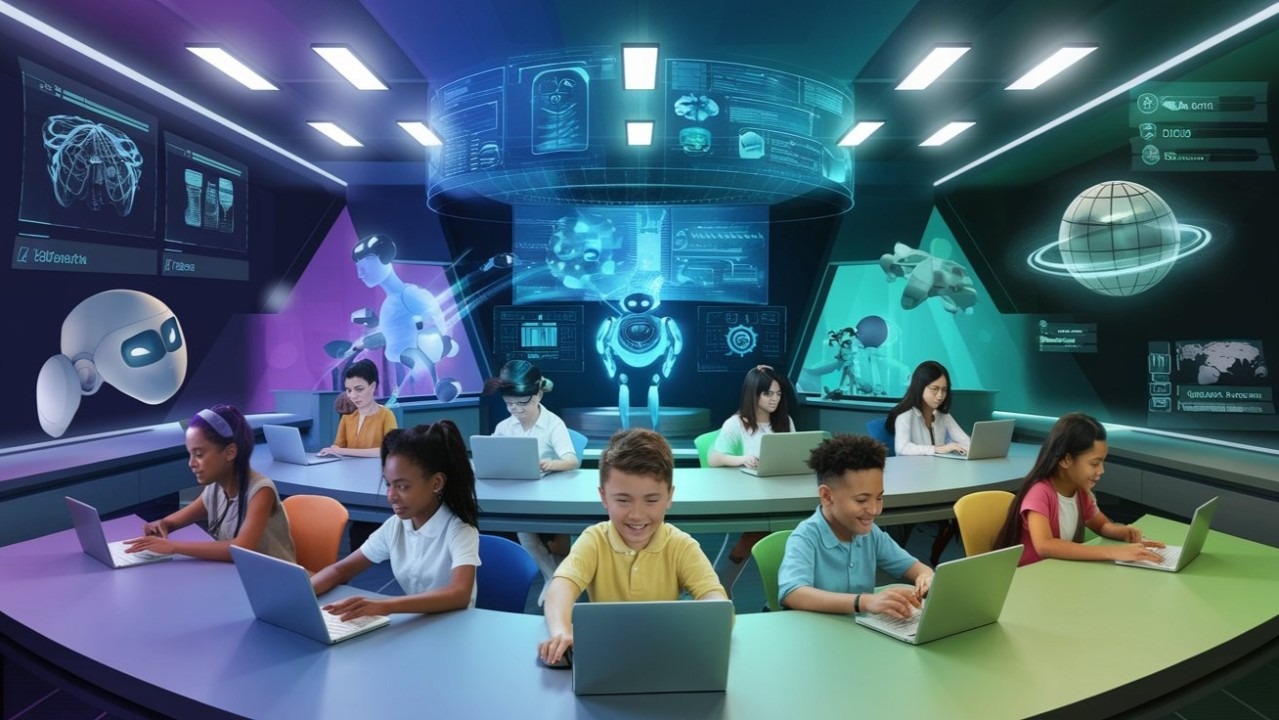
Over the years, education has taken a different turn. The students of today do not simply use textbooks and blackboards. Rather, they learn to use smartphones, tablet computers, and notebook computers. The reason this change is occurring is that the world is moving faster than ever. Modern Learning Tools have to evolve to keep pace. So, what are some ways that these tools are changing to meet the needs of modern learners?
Educational Product Trends: Adapting to a Changing Learning World
1. Textbooks to Digital Content
Previously, the study was predominantly done using heavy textbooks. This is because schools and colleges are now shifting to digital books and online resources. The e-books are lighter in weight, easy to carry, and can be updated in a short period. Moreover, lots of websites provide videos, quizzes and interactive lessons that make the process of education more entertaining.
As an illustration, a student can observe a 3D video of planets moving in space instead of simply reading about the solar system. This makes it pleasant to comprehend and recollect.
2. Personalised Learning
Among the most significant shifts, the emergence of personalised learning should be mentioned. All students have varied paces of learning. Some students are fast in maths and slow in reading. Just like how product description writing services tailor content to match different products, contemporary educational products apply artificial intelligence (AI) to learn the strengths and weaknesses of each student.
The contemporary educational products apply artificial intelligence (AI) to learn the strengths and weaknesses of each student.
It is now possible to have apps and websites that recommend what a student must learn next or rehearse. This implies that every student will receive a learning track that suits him or her. This was not easy to accomplish in large classrooms, but now technology enables it to be accomplished.
3. Gamification: How to Make Learning Fun
Children adore games. Thus, a lot of instructional products today teach through the use of games. The concept is referred to as gamification. In this approach, students will get points, badges or rewards upon completion of a task or a correct answer to a question. Many online coursework helpers also use gamification features to keep students engaged and motivated while working on their assignments.
This makes the students motivated and excited. The process of learning is less dull and turns into playing a game. To illustrate, applications such as Duolingo apply this technique to enable individuals to master new languages in an entertaining manner.
4. Toolkits: Hands-on and Interactive
The contemporary education products are also inclined towards practical learning. Students can experiment and practice as opposed to merely reading or listening.
E.g. science kits let students perform little experiments at home or in the classroom. In robotics kits, children learn to code and solve problems. Virtual labs allow students to perform chemical experiments on a computer.
These tools assist students in gaining deep ideas through doing, but not through reading.
5. Anytime, Anywhere Learning
The other major transformation is that learning is no longer confined to the classroom. Learning management systems, video lessons and educational applications enable students to study anywhere and at any time.
Online learning was the primary format in millions of students’ lives during the COVID-19 pandemic. Since schools reopened, a lot of students and teachers continue to use online tools because of their flexibility and convenience.
A student may now watch a math lesson during a bus ride or learn English vocabulary as he/she wait for a friend. This liberty assists the students in spending their time more wisely.
6. Groupwork and Communication Tools
There is an increasing need for teamwork and communication in modern learning. A lot of educational products today come with group projects, online discussions, and video conferencing tools.
Such applications as Google Classroom, Microsoft Teams, and Zoom allow students and teachers to be in contact with each other. Even when they are not in the same room, students can ask each other questions, share notes and collaborate on assignments.
This becomes highly helpful in the case of remote education or when students located in diverse regions of the world need to collaborate.
7. Emphasis on Future Skills
Previously, education was concentrated more on rote learning. However, the modern world requires not only knowledge. Employers are seeking individuals who are critical thinkers, problem solvers and are flexible to change.
Teaching these skills has become the subject of modern educational products. Numerous applications teach children to code, design, be literate in finance, and other useful specialist skills at a young age. Some platforms go as far as selling courses on how to be a creative thinker or deal with stress, the skills that come in handy in real life as well.
8. Helping Teachers and Parents
Educational products are not limited to students. Numerous tools can assist a teacher in planning lessons, checking assignments and monitoring progress without canning. Educators are able to identify the students who require additional assistance and change their approach to teaching.
These tools are also helpful to the parents. Lots of applications give parents an opportunity to monitor the progress of their child and get in touch with teachers. This forms a good network for the students, both at home and at school.
9. More Inclusive Learning
Formerly, most of the students with disabilities could not learn easily since the products were not targeted at them. More educational products now contain features for every type of learner.
As an illustration, text-to-speech aids struggling readers. Captions in video assist the deaf or hard-of-hearing viewers. Variable fonts and screen colours assist dyslexic students or those with vision issues.
Conclusion
One of the most significant portions of our lives is education. The world is changing, and learning must change as well. To ensure students learn better and are prepared to face the future, modern educational products are getting smarter, more fun and more flexible.
Whether it is digital books, virtual classrooms, games, or artificially intelligent tutors, they are defining the new ways of learning excitingly. All of us as students, teachers and parents can enjoy the changes, and anticipate a future in which learning will be simpler, more equitable and more enjoyable to all.
References
BAW.2019. Common Issues Faced By Students. Online Available at: <https://bestassignmentwriter.co.uk/blog/common-issues-faced-by-students/> (Accessed: 13- JUNE-2025).
van de Geer, S., & Klaassen, C. A. (2021). Willem van Zwet, teacher and thesis advisor. The Annals of Statistics, 49(5), 2448-2456.