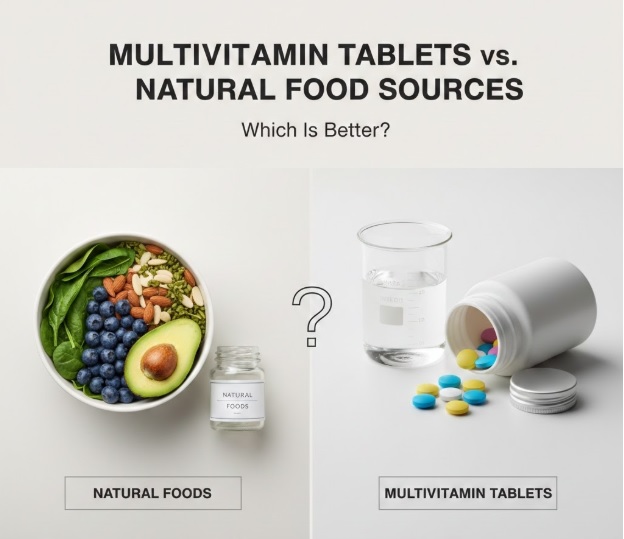
Good health is tied to good nutrition, but in the fast-paced world today, it is not always easy to meet the nutritional needs with food alone. While previous generations used raw fruits, vegetables, cereals, and home-prepared meals to source their vitamins and minerals, most of us do not manage to get enough nutrients from food. This has led to addressing the lack of nutrients with the best alternatives, namely multivitamin tablets, which can fill the nutritional shortage in just one tablet.
But the question is, are supplements truly equivalent in nutritional value to natural food sources, or are they merely a quick fix? Knowing the advantages and disadvantages of both approaches can help us make smarter choices for our bodies.
The Case for Natural Food Sources
Natural foods like fruits, vegetables, grains, nuts, dairy, meats, and fish deliver vitamins, minerals, fibre, and other healthy substances (like phytochemicals, antioxidants, and healthy fats) in combined states our bodies have adapted to use effectively. Key advantages:
- Synergy of nutrients: Foods have different nutrients that synergise; for instance, vitamin C increases iron absorption when eaten together in food.
- Fibre and other non-nutrient substances: Natural foods contain fibre (healthy intestines, digestion aid), flavonoids, polyphenol substances that pills from multivitamins often lack.
- Less likelihood of overdosage: It is harder to go over safe amounts when taking through a balanced diet than with supplements of high concentrations.
- Lower chance of missing co-factors: Certain nutrients require other vitamins and minerals to be absorbed effectively; natural foods typically arrive accompanied by those co-factors.
However, several hurdles exist, including lifestyle limitations (e.g., travel, unconventional eating), limited access to a variety of fresh foods, high costs, and the time required for meal preparation, which may make it challenging for certain individuals to rely solely on food as a source of all daily nutrients.
The Role of Multivitamin Tablets
Multivitamin tablets can be used to cover nutritional gaps. They are particularly beneficial when:
- Diet is limited (vegetarian, vegan, or allergies).
- Caloric need is low.
- Health disorders inhibit absorption.
- There’s a greater need (in case of pregnancy or intense physical activity)
- Lifestyle makes regular natural consumption a problem.
They provide convenience, predictability, and security (if well designed and used according to instructions), but they are supplements, not substitutes for a healthy diet. Some disadvantages are the risk of interference with drugs, the potential to exceed safe levels of certain nutrients, and, in some cases, decreased absorption or bioavailability relative to food sources.
Comparing Effectiveness: Tablets vs Foods
| Factor | Natural Food Sources | Multivitamin Tablets |
| Bioavailability & absorption | Usually greater due to co-nutrients and natural forms | Variable; formulation, types of vitamins/minerals, and individual health |
| Nutrient spectrum | Comprehensive, encompasses many non-vitamin compounds | May encompass many of the key vitamins/minerals but excludes non-nutrient bioactives |
| Safety / risk | Generally safe; toxicity uncommon if diet is balanced | Risk if overused; some nutrients accumulate and become toxic in excess |
| Convenience | Needs planning, shopping, cooking | Easy to swallow, convenient to take anywhere, guaranteed dosage |
| Cost | Varies; at times costly (fresh, exotic foods) | Variable; variable by brand and quality |
What Makes Naturyz Daily Multivitamin Extreme Energy Unique?
Naturyz’s Daily Multivitamin Extreme Energy with 35 Nutrients and 11 Energy Blend is different from other supplements in the following ways:
- It pairs 35 essential nutrients with an 11-energy-booster blend containing botanicals like ginseng, ashwagandha, and galanga. These support endurance, mental acuity, and physical performance on an everyday basis.
- Contains all but a few of the 100% Recommended Daily Allowance (RDA) for 23 of the key vitamins and minerals, providing a wide foundation of coverage against micronutrient deficiencies.
- Specifically formulated for individuals with active lifestyles, individuals who require an increase in energy and stamina to counteract fatigue, and for individuals whose food intake may fall short from time to time.
Naturyz also highlights “no artificial colour or flavour,” gluten-free and non-GMO, which appeals to health-conscious consumers. Thus, for someone who wants the convenience and targeted support a tablet can provide, especially when natural food intake is uneven, this is an ideal option.
Which Is Better—In Practice?
Ultimately, “better” depends on individual circumstances. For many, a mixed approach is the best:
- Prioritise natural, whole foods for the base: Vegetable-rich meals, fruits, whole grains, quality proteins, healthy fats.
- Reserve multivitamin tablets such as Daily Multivitamin Extreme Energy for filling gaps: Hectic lifestyle, food restrictions, after an illness, excessive physical or mental stresses.
Review medical professionals before selecting a supplement, particularly in special sections such as pregnant women, older adults, and individuals with chronic diseases
Final Thoughts
Natural foods are still the gold standard of nutrition: they provide balanced, multifunctional value at low risk. Multivitamin tablets do have their role, especially when they are well-formulated and used judiciously to supplement, not substitute a healthy variety of foods. A product like Naturyz Daily Multivitamin Extreme Energy with 35 Nutrients can be extremely useful in energising, closing nutritional gaps, and enhancing active living. But for all-around long-term health, natural food sources should still be the foundation of good nutrition.