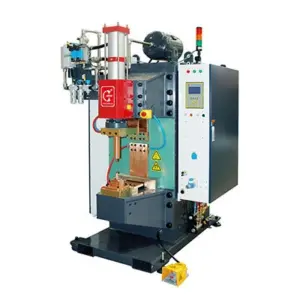
In today’s high-speed manufacturing environment, achieving precision, reliability, and efficiency in metal joining is essential. A resistance welder plays a pivotal role in meeting these demands, providing manufacturers with a versatile solution for connecting metals without compromising structural integrity. Heron Welder, a global leader in industrial welding technology, offers a comprehensive range of resistance welding machines designed to support OEMs, automation integrators, and factory decision-makers in optimizing production processes.
What Is a Resistance Welder?
A resistance welder is a type of welding equipment that joins metal components by applying pressure and passing a controlled electric current through the contact points. The heat generated from the resistance to the electrical flow melts the metal locally, creating a strong weld without the need for additional filler materials.
This method is highly efficient for repetitive, high-volume applications and is widely used in automotive, aerospace, electronics, and heavy machinery manufacturing.
Key Types of Resistance Welding Machines
Resistance welding comes in several forms, each suited to specific production needs:
-
Spot Welding Machines
-
Join two or more metal sheets at localized points.
-
Common in automotive body assembly and appliance manufacturing.
-
-
Projection Welding Machines
-
Focus the current on raised projections to create welds.
-
Ideal for complex assemblies and multi-spot connections.
-
-
Seam Welding Machines
-
Produce continuous welds along the length of the material using rolling electrodes.
-
Commonly used for tanks, drums, and HVAC components.
-
-
MFDC and Capacitor Discharge Welding
-
Medium Frequency Direct Current (MFDC) and Capacitor Discharge (CD) welders provide high precision for thin or specialized materials.
-
Perfect for electronics, battery packs, and delicate sheet metal assemblies.
-
Heron Welder offers all these systems with customizable options to suit automation workflows and production line integration.
How Does a Resistance Welder Work?
The principle behind a resistance welder is straightforward yet technologically advanced. The process involves:
-
Clamping the workpieces between electrodes.
-
Passing a high current through the contact points.
-
Generating heat through electrical resistance at the interface of the metals.
-
Applying pressure to consolidate the weld as the molten metal cools.
Modern systems from Heron Welder integrate advanced controllers that precisely regulate current, pressure, and timing, ensuring repeatable, high-quality welds.
Advantages of Using a Resistance Welder
Investing in a resistance welding solution provides manufacturers with several benefits:
-
High Production Efficiency: Rapid cycle times make resistance welding ideal for large-scale production lines.
-
Consistent Weld Quality: Automation and precise control systems minimize defects and reduce scrap.
-
Material Versatility: Capable of welding a wide range of ferrous and non-ferrous metals.
-
Cost-Effective: No filler material is required, and energy consumption is optimized with MFDC systems.
-
Automation Ready: Easily integrated into robotic or conveyor-based manufacturing systems.
Choosing the Right Resistance Welder
Selecting the correct resistance welder depends on several factors:
-
Material Type and Thickness: Spot welders are ideal for thin sheets, while projection and seam welders handle thicker or complex assemblies.
-
Production Volume: High-speed MFDC welders suit mass production, whereas CD welders are better for precision tasks.
-
Automation Integration: Consider whether the welder will be part of a robotic line or standalone operation.
-
Quality and Compliance Requirements: Ensure the system meets ISO or industry-specific standards for strength and safety.
Heron Welder assists manufacturers in evaluating these parameters to deliver customized, high-performance solutions.
Best Practices for Resistance Welding
To maximize the performance and lifespan of a resistance welder:
-
Regularly inspect electrodes and replace worn tips to maintain weld quality.
-
Monitor and maintain consistent pressure and current settings.
-
Keep workpieces clean and free of contaminants to ensure strong electrical contact.
-
Implement automated monitoring systems for data collection and process optimization.
-
Train operators on safety protocols and proper machine handling.
FAQs About Resistance Welders
Q1: Can resistance welding join dissimilar metals?
A1: Yes, but it requires careful control of current and pressure. Certain combinations may need specialized electrodes or MFDC/CD systems.
Q2: What industries commonly use resistance welders?
A2: Automotive, aerospace, electronics, appliance manufacturing, HVAC, and heavy machinery sectors are the primary users.
Q3: How long do resistance welder electrodes last?
A3: Electrode lifespan depends on material, weld frequency, and maintenance practices. Proper cleaning and replacement schedules extend durability.
Q4: Is resistance welding suitable for automated production lines?
A4: Absolutely. Modern resistance welders are fully automation-ready, compatible with robotic arms and conveyor systems for high-volume production.
Q5: What is the difference between MFDC and traditional AC welders?
A5: MFDC welders provide precise, low-energy, high-speed welding, especially suitable for thin metals or sensitive components, while traditional AC welders are more suited for general-purpose industrial applications.
Why Choose Heron Welder
As a trusted global manufacturer, Heron Welder combines engineering expertise with advanced technology to deliver reliable resistance welding machines tailored for modern industrial needs. From high-speed MFDC spot welders to projection and seam systems, Heron ensures quality, efficiency, and seamless integration into production lines worldwide.
Whether you are an OEM, automation integrator, or factory manager, Heron Welder provides solutions that enhance productivity, reduce downtime, and maintain consistent weld quality.
Take the Next Step: Explore Heron Welder’s full range of resistance welding machines or request a customized solution designed to optimize your manufacturing process. Contact us today for a quote or consultation.