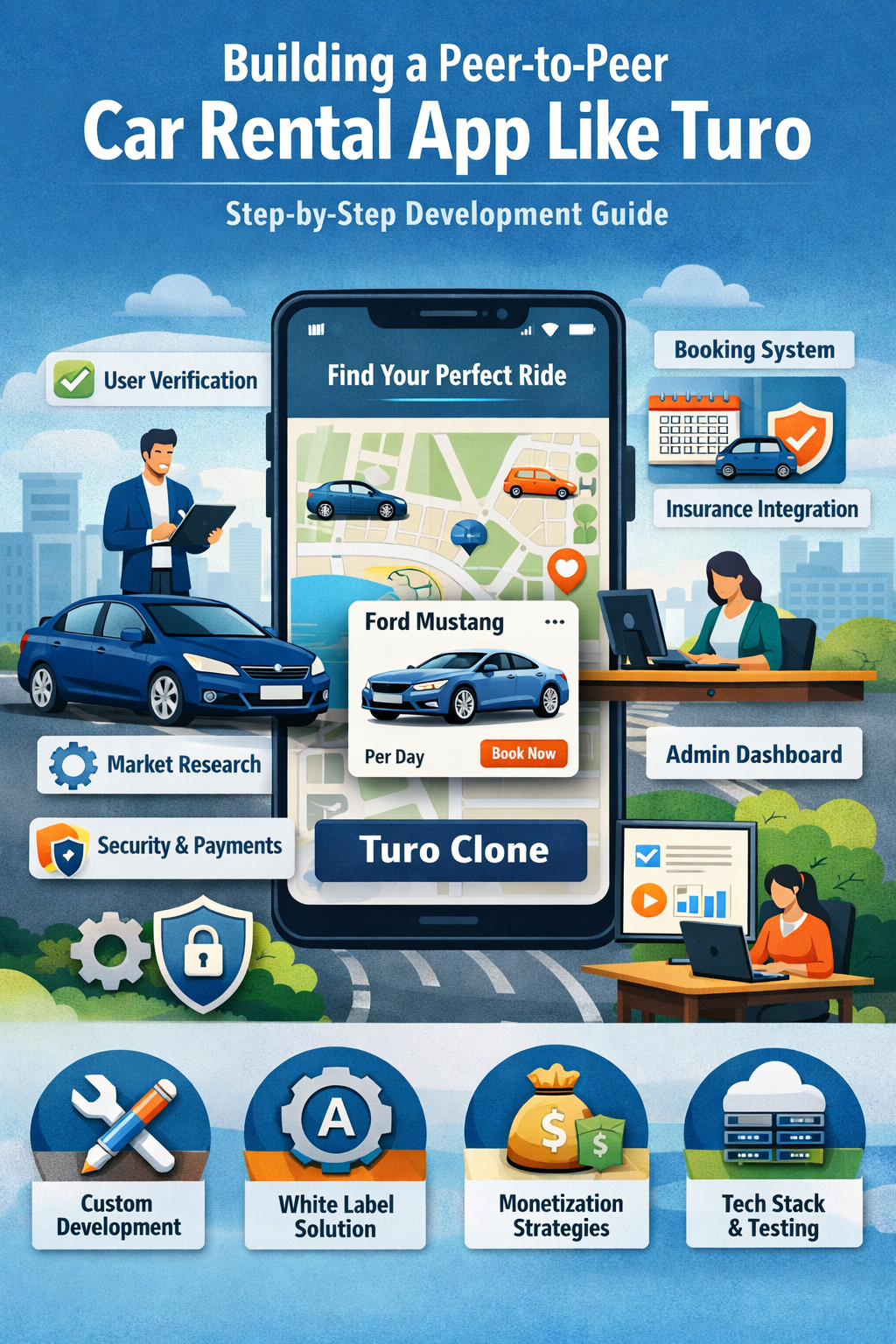
Peer-to-peer car rental platforms have transformed the traditional car rental industry by allowing private vehicle owners to rent out their cars directly to customers. Instead of managing a fleet, the platform acts as a digital marketplace that connects car owners and renters, manages trust, and facilitates secure transactions. A
Turo Clone follows this same principle, enabling entrepreneurs to build a scalable marketplace where supply is driven by individual car owners rather than corporate fleets.
This model reduces upfront investment, expands vehicle variety, and allows rapid geographic expansion. Revenue is typically generated through commissions, insurance add-ons, premium listings, and subscription plans. Before starting development, it is essential to understand how user trust, vehicle safety, and seamless booking experiences define the success of such platforms.
Key Features Required to Build a Peer-to-Peer Car Rental App Like Turo
A successful peer-to-peer car rental platform relies on feature completeness and smooth user experience. The application must support three primary user roles: car owners, renters, and administrators.
For renters, features such as advanced search filters, real-time availability, booking calendar, secure payments, in-app messaging, and reviews are essential. Car owners require vehicle listing management, pricing controls, availability scheduling, earnings tracking, and identity verification tools.
From an admin perspective, dashboard analytics, commission management, dispute handling, content moderation, and user verification systems are crucial. A White Label Turo Clone App typically comes with these core features pre-built, allowing businesses to customize workflows without starting from scratch.
Step-by-Step Development Process for a Peer-to-Peer Car Rental App
Developing a peer-to-peer car rental platform requires a structured and phased approach to ensure scalability and reliability.
Market Research and Business Planning
The development journey begins with in-depth market research. This includes analyzing local rental demand, user behavior, legal constraints, and competitor platforms. Defining your target audience, pricing strategy, and monetization model at this stage helps shape technical and design decisions later.
UI/UX Design and User Journey Mapping
Designing intuitive user flows is critical. Users should be able to search, book, and pay for a car within a few steps. Wireframes and prototypes help visualize the booking process, onboarding, and owner listing flows. A strong UI/UX foundation reduces friction and improves user retention.
Backend and Frontend Development
The backend handles core logic such as user management, booking rules, pricing algorithms, and payment processing. The frontend focuses on creating responsive interfaces for mobile and web users. Modern frameworks ensure fast performance and cross-platform compatibility, which is essential for scaling a Turo Clone.
Integration of Third-Party Services
Peer-to-peer rental apps rely heavily on integrations. Payment gateways, GPS tracking, insurance providers, identity verification tools, and push notification services must work seamlessly together. These integrations enhance security and build user confidence in the platform.
Testing and Quality Assurance
Before launch, the application undergoes rigorous testing. Functional testing ensures features work as expected, while security testing protects user data and transactions. Load testing is also important to ensure the platform performs well during peak demand.
Deployment and Post-Launch Support
Once testing is complete, the app is deployed to app stores and cloud infrastructure. Post-launch support includes monitoring performance, fixing bugs, and rolling out feature updates based on user feedback. Continuous improvement is key to staying competitive in the
car rental app development space.
Choosing Between Custom Development and a White Label Solution
Businesses often face a decision between building a platform from scratch or opting for a White Label Turo Clone App. Custom development offers full control but requires higher investment and longer timelines. White label solutions, on the other hand, provide ready-made architecture with customization options, significantly reducing time to market.
For startups and mid-sized businesses, white label solutions are often the preferred choice as they allow faster validation of the business model while maintaining branding flexibility.
Technology Stack and Security Considerations
A robust technology stack ensures performance and scalability. Cloud-based infrastructure supports dynamic traffic, while secure APIs handle data exchange. Data encryption, secure authentication, and compliance with regional regulations are critical for protecting user information.
Security also extends to vehicle safety and fraud prevention. Features like identity verification, trip monitoring, and review systems help create a trustworthy ecosystem for both renters and car owners.
Monetization Strategies for a Peer-to-Peer Car Rental App
Revenue generation can be diversified through multiple channels. Commission-based earnings on each booking form the primary income stream. Additional revenue can come from premium vehicle listings, subscription plans for car owners, insurance coverage options, and value-added services such as delivery and roadside assistance.
A well-designed monetization strategy ensures sustainable growth while keeping the platform attractive to users.
Conclusion
Building a peer-to-peer car rental app like Turo requires a clear understanding of the marketplace model, strong technical execution, and a focus on user trust. Whether you choose custom development or a
White Label Turo Clone App, success depends on delivering a secure, scalable, and user-friendly platform. With the right planning and execution, entrepreneurs can enter the growing mobility market and create a profitable digital rental ecosystem.
FAQs
What is a Turo Clone app?
A Turo Clone app is a peer-to-peer car rental platform that allows individual car owners to list their vehicles and rent them to users through a digital marketplace, similar to how Turo operates.
How long does it take to develop a peer-to-peer car rental app?
The development timeline depends on the approach. Custom development may take several months, while a white label solution can significantly reduce the time to market.
Is a White Label Turo Clone App suitable for startups?
Yes, white label solutions are ideal for startups as they lower development costs, reduce risk, and allow faster launch while maintaining branding flexibility.
What are the main challenges in car rental app development?
Key challenges include ensuring user trust, managing insurance and compliance, integrating secure payments, and maintaining platform scalability during high demand.
How can a peer-to-peer car rental app generate revenue?
Revenue can be generated through booking commissions, premium listings, subscriptions, insurance add-ons, and additional services offered to users.