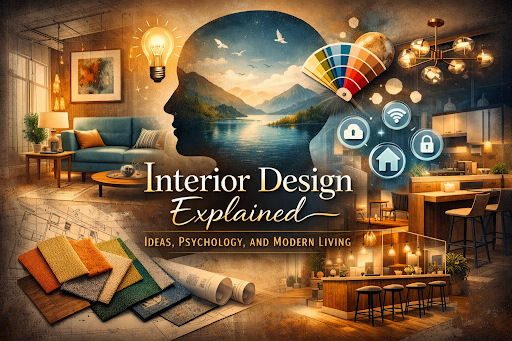
Interior design is much more than just the decoration of rooms and beautiful furnishings. It is a prudent activity, which is a combination of creativity, utility, psychology, and technology to influence the way people live, work, and communicate in an area. Since one can be at home or in the business setting, how to design seamless interiors to enhance the aesthetic value as well as comfort in our daily lives.
What Is Interior Design?
Interior design refers to the art and science of designing the indoor space so that it becomes effective, comfortable, and harmonious in appearance. It is a matter of knowing how individuals like to utilize a space and thereafter developing it as such. The interior is well constructed in that layout, material, lights, texture, and colors are taken into consideration to enable a harmonious interior as opposed to a visual disorder.
A good interior design is one that not only looks good but also allows movement, productivity, and relaxation. Each design decision is not without a reason, be it enriching the space with usability or with emotion.
The Interest of Interior Design
The aspect of interior design is intriguing since there can never be two spaces or users alike. Every project has to have a new attitude depending on the lifestyle, culture, and habits. Designers have to juggle between creativity and problem-solving; hence, the sphere is dynamic and thought-provoking.
It also changes with the technology and social trends. The interiors are constantly being transformed by the changing work patterns, eco-friendly materials, and intelligent living solutions that maintain the field of discipline as interesting and pertinent.
The way to create a smooth interior
Smooth interiors are areas where everything feels like a natural part of the interior. The design is not changed drastically in terms of style or color, but rather transitions between one space and another. This gives the feeling of serenity and continuity.
Key principles include:
- having a fixed color scheme
- having complementary materials used in the space.
- matching furniture size and room size.
An interior with seamless images does not create a visual obstacle and makes it seem natural and organized.
Smart Home Interior Design
The interior design of smart homes incorporates technology but does not overwhelm the design. This is aimed at rendering sophisticated systems non-invasive but available. The design has smart lighting, controlled temperature, and hidden storage features. A smart interior is also well planned to enhance convenience without compromising the clean and modern look. Technology is not to be distracting to the design, but rather to add to everyday life.
The Influence of Mental Health on Interior Design
The interior design directly affects psychological health. Stress and fatigue may be caused by poor lighting, crowded layouts, and severe colors. On the contrary, carefully planned interiors assist in emotional self-control and sanity.
The elements of design that impact positively on mental health include:
- open spaces and natural lighting.
- calming color schemes
- orderly, clean rooms.
The interiors that facilitate comfort and calmness in turn enhance mood and concentration.
How to become a better interior design
To improve on interior design, observation, patience and constant learning are required. Instead of adhering to the trends, effective designers are preoccupied with studying of space and human behavior.
Improvement comes from:
- observing interiors in reality.
- playing with textures and lighting.
- focusing on usefulness over beauty.
- Good design prowess is built with time, care, and observation.
How to Design an Office Interior
Commercial interior design is based on functionality, branding, and user experience. Offices and retail stores, as well as hospitality areas, should be able to help in achieving business objectives and be aesthetically appealing.
Among the aspects that should be taken into account, it is important to note:
- effective movement space planning.
- brand-equivalent lighting.
- long-lasting materials to be used.
An excellent commercial interior design produces a lasting impact and makes it more comfortable and functional.
The Uses of Mirrors in Interior Decorating
Mirrors are good design resources when appropriately employed. They are light refractors, form visual depth, and open small spaces. Opposite windows are mirrors that help in natural lighting and make the interiors shine naturally.
Poor placement may, however, create visual confusion. Mirrors are strategically used to provide balance and prevent clogging of the space by designers.
Lighting in interior design by Designers
One of the aspects that matters most in interior design is lighting. Layered lighting is used by designers to produce a sense of atmosphere and functionality.
Lightings normally comprise:
- ambient lighting to provide general lighting.
- focused activity task lighting.
- functional lighting to show features.
The proper lighting changes the environment that affects the mood and perception.
Conclusion
Interior design consists of creative, useful, and psychological thinking. It creates environments, when carried out well, that are not only aesthetically advanced but also enhance life in general. In smart homes as well as business interiors, the design decisions will have a direct influence on comfort, efficiency, and mental state, and interior design becomes an indispensable aspect of contemporary life.