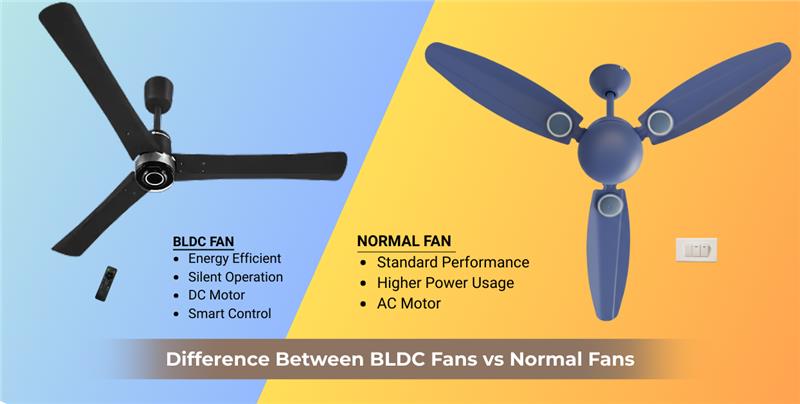
With rising electricity costs and increasing awareness about energy efficiency, household appliances are evolving rapidly. One such innovation that has transformed the ceiling fan industry is the BLDC fan. BLDC fans are gaining popularity in homes, offices, and commercial spaces due to their low power consumption, advanced technology, and long-term cost savings.
This article explores What is BLDC Fan, how it works, its components, benefits, drawbacks, and how it compares with traditional AC fans.
Understanding What a BLDC Fan Is
A BLDC fan is a ceiling fan that operates using a Brushless Direct Current (BLDC) motor instead of a conventional AC induction motor. Unlike traditional fans that run directly on alternating current (AC), BLDC fans convert AC power into direct current (DC) internally before operating the motor.
The absence of brushes in the motor design reduces mechanical wear and energy loss, making BLDC fans significantly more efficient and durable. These fans are designed to deliver consistent air circulation while consuming far less electricity than standard ceiling fans.
How a BLDC Fan Works
The working mechanism of a BLDC fan is different from that of a traditional fan. The electricity supplied to homes is AC, but BLDC fans rely on DC power. To bridge this gap, BLDC fans include an internal controller or driver.
First, the AC supply is converted into DC using a rectifier circuit. This DC power is then regulated by a microcontroller that precisely controls the speed and torque of the motor. The microcontroller switches the current electronically rather than mechanically, eliminating the need for brushes.
Because the motor is electronically commutated, it operates smoothly with minimal friction and heat generation. This results in efficient performance, stable speed even during voltage fluctuations, and reduced noise.
Key Components of a BLDC Fan
BLDC fans are built using advanced components that differentiate them from conventional fans.
The most important component is the brushless DC motor, which uses permanent magnets on the rotor and electromagnets on the stator. The electronic controller replaces the mechanical commutator found in traditional motors.
Another crucial component is the driver circuit, which converts AC power to DC and manages motor operation. The microcontroller unit (MCU) ensures precise speed control and supports features such as remote operation and timer functions.
BLDC fans also include specially designed blades that maximize airflow while minimizing energy consumption. High-quality bearings further reduce friction and improve lifespan.
Power Consumption of BLDC Fans
One of the biggest advantages of BLDC fans is their extremely low power consumption. A typical conventional ceiling fan consumes between 70 to 90 watts at full speed. In contrast, a BLDC fan usually consumes only 25 to 35 watts, depending on the model and speed setting.
Over long periods, this difference translates into substantial energy savings. For households using multiple fans for several hours daily, switching to BLDC fans can reduce electricity bills significantly. This makes BLDC fans an ideal choice for energy-conscious consumers.
Benefits of Using a BLDC Fan
BLDC fans offer several advantages that make them superior to traditional fans in many aspects.
Energy Efficiency
The primary benefit of a BLDC fan is its energy efficiency. Consuming up to 65% less power than conventional fans, BLDC fans help reduce electricity usage without compromising airflow or comfort.
Consistent Speed Performance
BLDC fans maintain a constant speed even during voltage fluctuations. Traditional fans tend to slow down when voltage drops, but BLDC fans remain unaffected due to their internal voltage regulation system.
Quiet Operation
Since BLDC motors do not use brushes, there is minimal friction and mechanical noise. This makes BLDC fans exceptionally quiet, ideal for bedrooms, study rooms, and offices.
Longer Lifespan
The brushless design reduces wear and tear, increasing the operational life of the fan. With fewer moving parts subject to friction, maintenance requirements are also lower.
Remote and Smart Control
Most BLDC fans come with remote controls that allow users to adjust speed, activate sleep modes, or set timers. Some advanced models also support smart home integration and mobile app control.
Environmentally Friendly
By consuming less power, BLDC fans contribute to lower carbon emissions. They are a sustainable alternative that supports energy conservation and environmental protection.
Drawbacks of BLDC Fans
Despite their many benefits, BLDC fans also have some limitations that buyers should consider.
The most noticeable drawback is the higher initial cost. BLDC fans are more expensive than conventional ceiling fans due to their advanced technology and electronic components.
Another limitation is dependence on electronic components. If the driver circuit fails, repairs can be costlier compared to repairing a traditional fan motor. Additionally, BLDC fans may require specialized service support.
Some users also find the remote control dependency inconvenient, although most models include manual wall regulators as a backup.
Comparison Between BLDC Fans and Conventional Fans
When comparing BLDC fans with traditional AC fans, several differences stand out.
In terms of power consumption, BLDC fans clearly outperform conventional fans. While airflow levels are comparable, BLDC fans deliver this performance at much lower energy costs.
Speed stability is another major difference. Conventional fans are affected by voltage fluctuations, whereas BLDC fans maintain consistent speed.
Noise levels are also lower in BLDC fans due to the absence of brushes. In contrast, traditional fans may become noisy over time due to mechanical wear.
Although BLDC fans have a higher purchase price, their long-term savings often outweigh the initial investment, making them more cost-effective in the long run.
Applications of BLDC Fans
BLDC fans are suitable for a wide range of applications. In residential settings, they are commonly used in living rooms, bedrooms, and kitchens due to their energy efficiency and quiet operation.
In offices and commercial spaces, BLDC fans help reduce electricity expenses while maintaining a comfortable environment. They are also widely used in areas with unstable voltage supply because of their consistent performance.
BLDC fans are particularly beneficial in regions where ceiling fans run for long hours daily, such as tropical climates.
BLDC Fans and Power Backup Systems
One of the lesser-known advantages of BLDC fans is their compatibility with power backup systems. Because they consume less power, BLDC fans can run longer on inverters and batteries during power cuts.
A BLDC fan can operate for nearly twice as long as a conventional fan on the same inverter capacity. This makes them an excellent choice for homes that experience frequent power outages.
Maintenance Requirements
BLDC fans require minimal maintenance compared to traditional fans. The brushless motor design eliminates frequent issues such as sparking, overheating, and mechanical wear.
Regular cleaning of blades and periodic inspection of electrical connections are usually sufficient to keep the fan in good working condition. With proper care, BLDC fans can operate efficiently for many years.
Future of BLDC Fan Technology
As energy efficiency becomes a global priority, BLDC fan technology is expected to see widespread adoption. Manufacturers are continuously improving designs, integrating smart features, and reducing costs.
With advancements in electronics and mass production, BLDC fans are becoming more affordable and accessible. Their compatibility with renewable energy sources such as solar power further enhances their relevance in the future of sustainable living.
Conclusion
A BLDC fan represents a significant advancement in ceiling fan technology. By using a brushless DC motor and intelligent electronic controls, BLDC fans deliver high performance with remarkably low power consumption. They offer quieter operation, longer lifespan, consistent speed, and substantial energy savings.
Although the initial cost may be higher, the long-term benefits make BLDC fans a smart investment for modern homes and workplaces. As energy efficiency and sustainability continue to gain importance, BLDC fans are set to become the standard choice for cooling solutions.