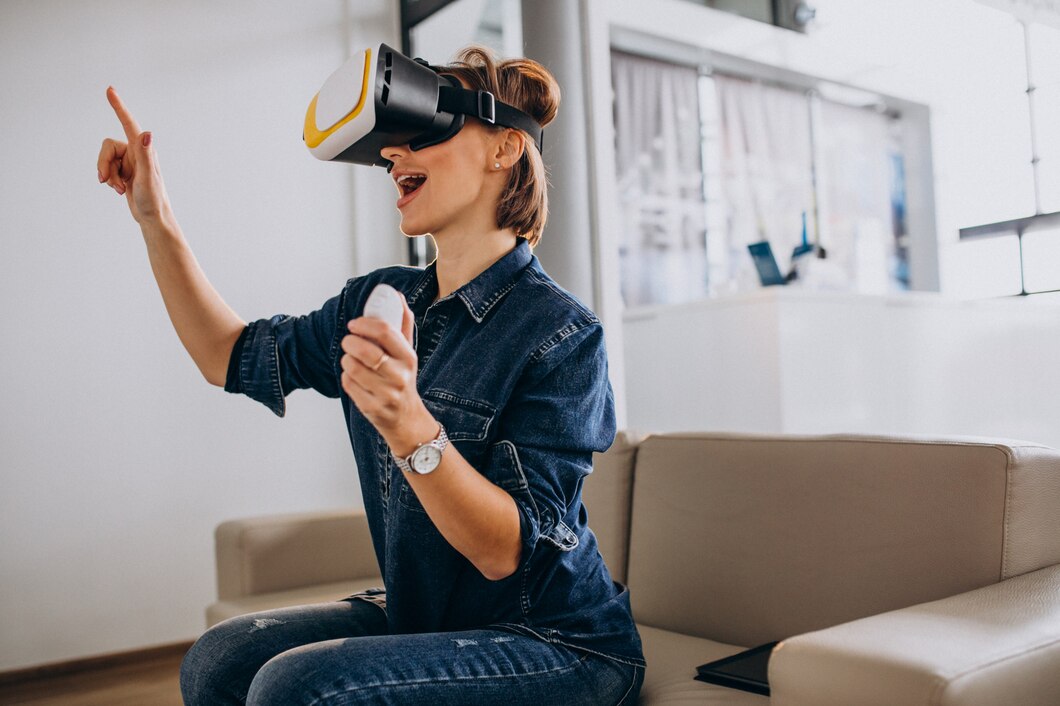
The process of purchasing a house is a long-standing tradition based on the weekend field trip, physical fatigue, and sometimes the toilet training failure, where what appears to be a nice house listing is actually like a horror movie. Nevertheless, the business is being digitally facelifted. The VR in Real Estate is no longer a concept of the future science fiction film; it is a practical potent application that is now redefining the way in which properties are bought, sold and designed.
Whether a realtor wants to remain competitive or a buyer wants to find their dream home three states away, it is crucial to learn about the influence of VR In Real Estate. With the integration of the physical and the virtual, we are going through a period when the walkthrough occurs on your own schedule, time and place.
Why Modern Property Experts Are Using VR?
The real estate business is driven by passion and imagery. A buyer finds themself oftentimes unable to gaze upon a flat 2D blueprint or a gallery of stationary images and envision their life in the space. That is where Virtual Reality in Real Estate comes in.
Potential buyers can also enter a property using immersive headsets or even interactive 360-degree web portals. This sense of presence will cause an emotional bond that is not possible in traditional media. Moreover, Extended Reality solutions also enable agencies to provide an element of transparency and detail, which gives an instant trust to high-value clients.
The Major Benefits for Sellers and Buyers
- Time Saving: No longer wasting time on getting to the properties that do not fit. You can explore ten houses within thirty minutes.
- International Access: A customer in London will be able to visit a penthouse in New York as easily as their neighbour.
- Lowered expenses: To the developers, VR in Real Estate will remove the physical model home, which is costly to construct.

Exploring the Most Effective Uses for Virtual Reality
One can simply define VR as fancy 360 photos, but there is a lot more to it. XR in Real Estate is an area of activity that includes diverse applications meeting specific pain points in the property lifecycle.
1. Virtual Guided Tours
A VR tour is non-linear, unlike a standard video. You have the option of hanging around the kitchen waiting to see the cabinet finishes or getting out onto the balcony to view the simulated view. These tours may be guided or self-guided, with an agent present in the virtual session to answer questions in real-time, or self-guided just to explore it independently.
2. Virtual Staging
Any empty house tends to be cold and seeming that the house is not as big as it is. Physical staging of a home, however, is costly and time-consuming and involves ordering furniture. Using VR in Real Estate, the agents will be able to furnish a space virtually, in any of the possible styles: modern, rustic, or minimalist, to allow buyers to see the possibilities in a home.
3. V-Commerce (Virtual Commerce)
Think of virtual apartment touring, like the living room sofa. Of course, you can do it with in-built VR In Real Estate platforms, and just by clicking on the item, you will be able to see its size, cost, and even buy it for your future house in real time.
How Developers Benefit From Virtual Reality During Construction?
Buying off-plan is considered one of the most stressful things in real estate, as it is a purchase that has not been constructed before. It needs a giant of a leap of faith. Virtual Reality in Real Estate eliminates that doubtfulness.
Developers currently use the XR services to build a full-sized walkable environment of buildings, even before the first stone is set down. This will enable the buyers to view the actual height of the ceilings, direction of the hallways and the amount of natural light that may come into the room at various times of the day.
Streamlining the Design Process
To architects and interior designers, XR in Real Estate can be used as a joint sandbox. Clients are able to make requests, such as the idea of moving a wall or substituting hardwood with tile, and see it occur in real-time in the virtual world. This eliminates remorse on the part of the buyer and dramatically reduces the costly mid-construction.
What the Future Holds for VR In Property Technology
We are heading towards a Phygital world, a physical-digital world. Very soon, Virtual Reality in Real Estate will involve the use of haptic feedback and even artificial intelligence-based virtual assistants that will serve as 24-hour tour guides.
Although the advantages are apparent, there is still a question of whether the technology is overly complicated. The fact is that the barrier to entry is decreasing on a daily basis. The Virtual Reality in Real Estate does not necessarily require an expensive headset. The majority of new platforms are browser-based, and a smartphone and a plain viewer made of cardboard are sufficient to offer an immersive experience.
Final Thoughts
It is not merely a fad that is causing the transformation of Real Estate to Virtual Reality; it is a complete change in how the industry operates. It gives the buyer power, saves time for the agent, and gives a security net to the developer. Using VR In Real Estate, we are to eliminate the physical walls that once restricted our options, and we will be able to navigate the most beautiful corners of the world, from the comfort of our present houses.
With the digital horizon in our newly sighted, boundaries between our physical environment and the virtual opportunities will still continue to be blurred, making the experience more exciting and connected to all.