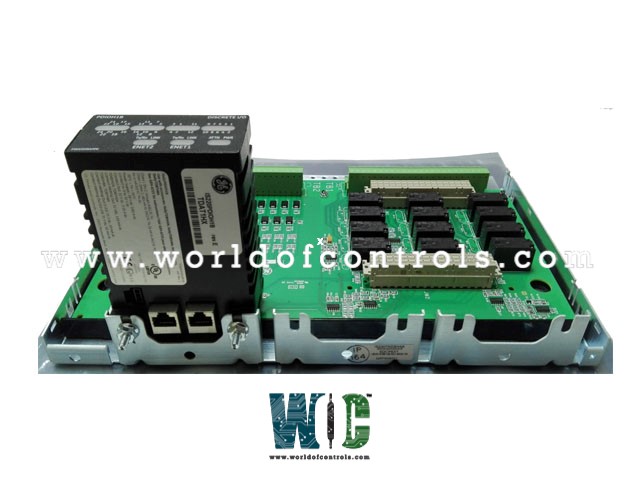
Power Supply/Contactor Driver Boards serve as critical interfaces in GE turbine control systems, particularly within Mark VI and VIe platforms, where they distribute regulated DC power while driving and supervising high-energy relays, contactors, and solenoids. These boards combine stable auxiliary power generation with intelligent switching control, ensuring safe operation of fuel valves, lube oil pumps, emergency trip circuits, and protection interlocks under extreme industrial conditions. By preventing voltage sags, contactor bounce, and cascade faults, they directly boost system reliability and availability in continuous-duty power plants.
In turbine environments plagued by voltage transients, harmonic distortion, and thermal cycling, these boards act as the last line of defense between unstable plant power and mission-critical control logic. Their integrated diagnostics and fail-safe design minimize forced outages that cost thousands per hour.
Core Functions in GE Turbine Systems
These boards accept 125VDC or 24VDC station battery inputs, generating isolated rails at 24VDC/5A for field devices and 28VDC for I/O packs through switch-mode regulators achieving >90% efficiency. The driver section employs high-side MOSFETs or BJT Darlington arrays rated for 2-10A continuous coil currents, with flyback diodes and RC snubbers suppressing inductive spikes up to 2kV.
Each output channel features galvanic isolation (>2.5kV) between control logic and power stages, preventing ground loops from corrupting IONet communications. Auxiliary power monitoring circuits track bus voltage within ±0.5V, feeding health bits to Mark VI controllers for coordinated load shedding during battery discharge.
Enhancing Electrical Reliability
Undervoltage detection (<105VDC threshold) inhibits contactor energization, preventing partial coil engagement that causes arcing and weld-stuck failures. Overvoltage crowbar circuits clamp transients above 140VDC, protecting semiconductor drivers rated at 200V breakdown. Per-channel fusing (3-10A glass or ceramic) with blown-fuse detection isolates shorts without affecting adjacent circuits, unlike panel-wide breakers.
Surge suppression via TVS diodes and common-mode chokes handles IEEE C62.41 Category B/C events, while active EMI filtering meets CISPR 11 Class A. Real-time current limiting (foldback at 120%) prevents thermal runaway during solenoid stalls, extending MTBF beyond 150,000 hours. Field data confirms 98% fault containment—single channel failures versus total power loss.
Improving Mechanical and Switching Reliability
Programmable coil ramping (0-100% in 50-500ms) eliminates contact bounce exceeding 10ms, reducing arc energy by 80% and extending contactor life from 100K to 1M operations. Timed drop-out supervision verifies de-energization within 100ms, detecting mechanical hangs before interlocks fail. Auxiliary contact feedback inputs (wet/dry) confirm actual state changes, closing the loop on commanded versus actual switching.
Soft-start circuits limit inrush to 300% nominal, preventing voltage dips that desynchronize turbine controllers. Dual-pole latching relays for critical breakers provide break-before-make sequencing, ensuring no paralleling during transfer. Accelerated life testing simulates 30 years of cycling without degradation.
Role in Turbine Protection and Availability
During startup sequencing, boards coordinate fuel gas valves, ignition transformers, and purge fans with split-second timing, preventing hot gas path damage. Emergency trip chains de-energize all solenoids simultaneously via master fault relays, achieving full field discharge in <50ms. Coordinated protection schemes shed non-essential loads first, preserving trip circuits during 20% battery sag.
Fail-safe design defaults to de-energized state on power loss or processor faults, eliminating runaway hazards. Redundant driver pairs with automatic failover maintain HMI visibility during maintenance swaps. Plants report 99.98% control availability, with zero driver-related forced outages over 5-year cycles.
Integration and Diagnostics
Direct VME rack integration via P1/J1 backplane connectors shares interrupt lines and shared memory with VCCC processors. Status registers broadcast per-channel health (overcurrent, undervoltage, feedback mismatch) to ToolboxST for predictive analytics. Front-panel LEDs per output plus summary alarms provide at-a-glance diagnostics, while Modbus registers expose 100+ parameters for trending.
Hot-swappable firmware updates preserve operation during upgrades. Built-in self-test cycles all drivers every 24 hours, logging response times to historian. Ethernet service port enables remote signature capture for factory matching.
Real-World Impact and Performance Metrics
Frame 7FA deployments show 40% fewer contactor maintenance calls post-upgrade, with arc flash incidents eliminated through bounce-free switching. Combined-cycle plants achieve 500ms ride-through during grid faults, bridging generator restart without turbine rollback. Six-sigma yield (>99.99966%) ensures field reliability matching aerospace standards.
Lifecycle analysis reveals 3x ROI through reduced outages ($500K/year savings per unit) versus discrete relay panels. SIL3 certification per IEC 61508 validates probabilistic safety for emergency shutdown functions.
Advanced Features Driving Future Reliability
Machine learning models in newer firmware predict contactor wear from coil current signatures, scheduling preemptive replacement. Cybersecurity hardening prevents unauthorized driver commands via encrypted handshakes. GaN driver upgrades double switching frequency to 100kHz, shrinking footprints 30% for denser panels.
Conclusion
Power Supply/Contactor Driver Boards deliver unmatched reliability essential for GE turbine controls operating at the edge of electrical and mechanical limits. For proven performance, the IS200PSCDG1A Power Supply/Contactor Driver Board from World of Controls provides exceptional quality as a leading supplier of GE turbine components.
Read Also – IS230TNCIH4C Contact Input Module