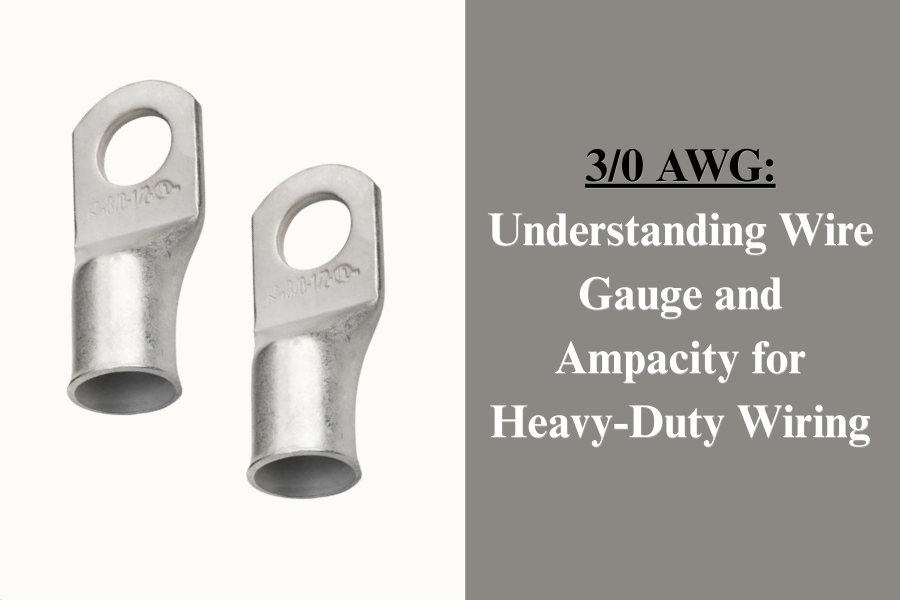
When you’re working with high-demand electrical systems, the wire you use can make or break your setup. Heavy-duty applications like large inverters, multi-battery banks, marine systems, and off-grid power – need wiring that can move high current safely and reliably. That’s exactly where 3/0 AWG stands out as a dependable choice.
If you’re upgrading or building a system designed to move a lot of power, understanding wire gauge, ampacity, and the role of secure connections is essential. And once you’re working in this range, using the right 3/0 AWG tinned lug becomes just as important as choosing the right cable.
This guide breaks down what 3/0 AWG really means, why it’s used in heavy-duty setups, and how 3/0 AWG tinned lugs help you get the performance and safety you expect.
What 3/0 AWG Really Means
The American Wire Gauge (AWG) system can feel a bit confusing at first. The numbers go down as the wire size goes up, and once you reach “0” you move into “aught” sizes.
3/0 AWG—often written as 3 0 AWG or 3/0 AWG—is one of the thicker cables used in mobile, marine, and industrial power systems. Its large diameter allows it to carry high current without overheating or suffering performance loss.
Why size matters:
- A thicker wire has less resistance.
- Less resistance means lower voltage drop.
- Lower voltage drop helps high-draw equipment run smoothly.
- Bigger wires stay cooler under heavy loads.
For systems where current flow is high, long, or continuous, 3/0 AWG offers a safety margin you can rely on.
Ampacity: How Much Current Can 3/0 AWG Handle?
Ampacity refers to the maximum current a wire can carry safely. This depends on the insulation type, length, temperature rating, and installation environment.
On average, 3/0 AWG copper wire supports:
- 165–200 amps in most mobile/RV/marine environments
- 200–225 amps in open-air or well-ventilated setups
- Up to 300 amps in certain industrial conditions with proper insulation
This makes it a go-to choice for:
- Large inverters (3000W–5000W)
- Multi-battery banks
- Heavy-duty alternator charging
- Solar system bus bars
- Marine power distribution
- Industrial machinery
If your setup deals with high current for long periods, 3/0 AWG helps prevent overheating, keeps voltage stable, and protects your equipment.
When You Should Consider 3/0 AWG
Not every system needs this size, but certain setups benefit from it right away. You should consider upgrading to 3/0 when:
- Your inverter shuts off under load
- Your cables get warm to the touch
- Voltage drops when a heavy appliance starts
- You’re installing a high-output alternator
- You’ve moved to lithium batteries with faster charging
- Your cable runs are longer than usual
- Your boat or RV has frequent power dips
In these situations, the wiring is usually the bottleneck. Upgrading to 3/0 AWG often solves these issues without replacing the entire system.
Why 3 0 AWG Tinned Lug Matters in Heavy-Duty Wiring
With larger wire sizes, the lug you use matters just as much as the cable. To keep connections secure and efficient, most installers turn to 3/0 AWG tinned lugs in RV, marine, and off-grid systems.
Benefits of 3/0 AWG tinned lug:
- Corrosion resistance: Because the copper is coated in tin, it holds up better against moisture and salt – perfect for humid and coastal setups.
- Low resistance: Copper already conducts well, and tin helps maintain clean contact over time. This keeps voltage drop low and performance stable.
- Stronger crimping: They stay solid and grip the cable securely, which matters a lot with thick wires that handle big currents.
- Long life: Even when exposed to vibration, heat cycles, and the elements, tinned lugs stay reliable for years.
Even the best cable won’t perform well if the lug is weak. Using the right 3/0 AWG tinned lug helps keep your system safe and dependable.
Where 3/0 AWG Tinned Lugs Are Most Common
These heavy-duty 3 0 AWG tinned lugs are widely used in:
- Battery banks on RVs and boats
- Inverter hookups
- Trolling motor wiring
- Solar charge controllers and power centers
- Off-grid cabins
- Industrial control panels
- Backup power systems
Whenever you’re dealing with high power and thick cables, these lugs help maintain stable connections.
Choosing the Right 3/0 AWG Tinned Lug
Before buying, make sure you match the lug to your system:
- Pick the correct stud size
Battery posts and bus bars vary – common stud sizes include 5/16”, 3/8”, and 1/4”.
- Go for seamless construction
A seamless 3 0 AWG tinned lug handles crimping pressure better and avoids weak spots.
- Choose marine-grade quality
This ensures better corrosion protection and long-term reliability.
- Use heat shrink tubing
Sealing the connection keeps moisture out and reduces wear.
Good quality 3/0 AWG tinned lugs follow these standards, offering clean finishes and solid contact points that installers trust.
Installation Tips for Best Performance
Even the best 3 0 AWG tinned lug needs a proper installation. A clean, tight crimp improves safety and keeps the connection stable.
- Use a heavy-duty hydraulic crimper
- Strip the cable cleanly without damaging strands
- Make sure the lug fits snugly
- Apply firm pressure when crimping
- Seal with adhesive heat shrink
- Check the connection after tightening
A good installation can last years with little maintenance.
Building Safe and Reliable Power Systems
High-power systems need wiring that can handle heavy current safely. 3/0 AWG is thick, strong, and built for demanding setups – RVs, boats, or off-grid homes. Using the right 3/0 AWG tinned lug ensures your connections stay solid, resist vibration and moisture, and last for years.
When working on a high-current system, using reliable components makes a big difference. Check out Selterm’s 3 0 AWG tinned lugs, they give you strong, safe connections for a better, more efficient setup.